
How to Build a Strong Social Media Presence for Your Brand

A strong brand presence on social media is not measured by how many accounts a business opens. It is created when the right audience repeatedly encounters useful, recognisable content and receives a reliable response. That requires strategy, editorial judgement, clear ownership and a website journey capable of supporting the interest social content creates.
For UK business owners, social platforms can support awareness, trust, customer service, recruitment, education and sales—but rarely all in the same way. Wix Solutions helps brands choose a realistic role for each channel, build a coherent content system and connect social activity with useful pages, forms, bookings and CRM follow-up.
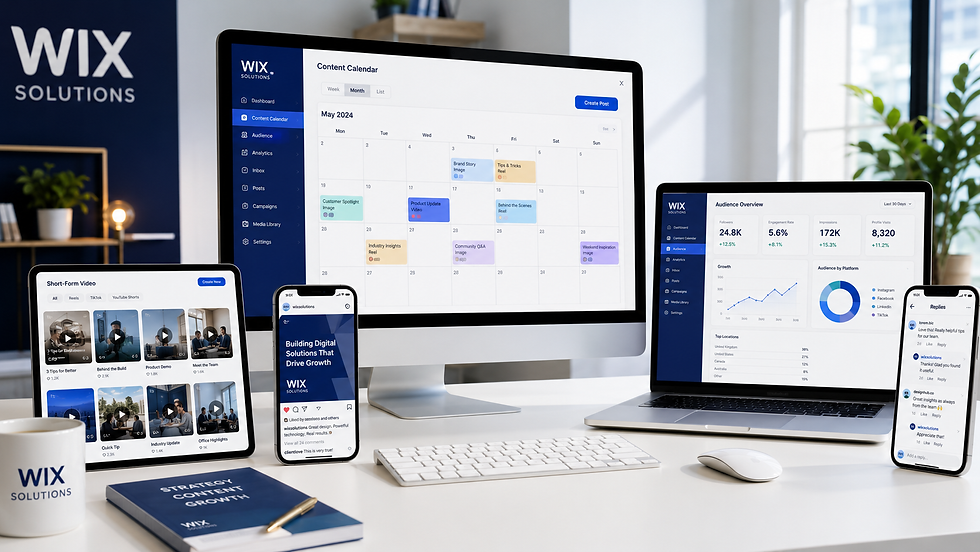
What Is a Strong Social Media Presence?
A strong social media presence is a consistent, useful and responsive expression of the brand across the platforms its audience actually uses. It reflects the business accurately, gives people a reason to follow or return, and makes the next step proportionate to their level of interest.
It does not require constant posting. A smaller organisation may publish less frequently and still build recognition if its content answers real questions, demonstrates expertise and participates in relevant conversations. Sustainable quality is more credible than bursts of activity followed by long silence.
Build Your Social Media Presence on Clear Objectives
Before choosing content formats, decide what social media should help the business accomplish. One primary objective per planning period is usually easier to manage than a list of competing ambitions. An architectural practice may prioritise qualified enquiries, while a ceramics studio may focus on workshop bookings and repeat community participation.
Awareness: reach relevant people and make the brand easier to recognise.
Education: explain products, services, processes or decisions that customers find difficult.
Trust: show evidence, expertise, standards and the reality behind the offer.
Community: encourage discussion, participation, user contributions and repeat attention.
Customer support: answer recurring questions and direct account-specific issues to secure channels.
Conversion: help interested people move to an appropriate page, enquiry, booking or purchase.
Retention: give existing customers reasons to return, learn, renew or recommend.
Know the Audience Beyond Demographics
Age and location can be useful, but a practical audience definition also includes situations, questions, constraints and information needs. What is the person trying to decide? What evidence will they require? What might prevent them from acting? Which content format can answer that question without creating unnecessary effort?
Audience research can draw on enquiries, sales conversations, customer-service logs, website searches, reviews, comments and analytics. The aim is not to create a fictional persona with decorative details; it is to identify repeatable needs that inform useful content.
Choose Platforms by Role, Not Popularity
Each platform should have a defined role and an owner. A professional-services firm may use LinkedIn for insight and recruitment, then direct readers to detailed website resources. A visually led maker may use Instagram for process and community, while email and the website handle bookings or product information. A local service company may benefit more from a well-maintained profile and helpful project evidence than from trying to entertain on every channel.
Consider audience fit, content format, moderation workload, organic discoverability, paid options, data requirements and the team’s ability to respond. It is better to manage two relevant channels well than five channels badly.
Create Content Pillars That Support the Customer Journey
Content pillars are recurring themes that help a team plan without repeating the same post. Useful pillars often include education, proof, process, people, product or service, customer questions and community. Every pillar should link to a business or audience need.
Education: guides, myths and facts, explanations, checklists and decision support.
Proof: case studies, project details, reviews, demonstrations and independently verifiable evidence.
Process: behind-the-scenes work, methods, standards and what customers can expect.
Perspective: informed commentary on relevant changes, challenges or design choices.
Participation: questions, polls, workshop content, community features and user contributions with permission.
Offer: clear product, service, event or booking information presented at a sensible frequency.
Plan a Sustainable Publishing Rhythm
A useful calendar balances preparation with responsiveness. Batch evergreen content where possible, but leave space for timely questions, project updates and community conversation. Define who drafts, checks, approves, publishes and responds. Regulated or technical sectors may also require subject-matter review.
Repurposing is efficient when the content is adapted, not simply copied. One detailed article can become a concise carousel, a short video explanation, an email summary and several question-led posts, each leading back to the complete resource.
Community Management Is Part of the Strategy
Publishing without responding is broadcasting, not community building. Set response standards for comments, direct messages, complaints, spam and sensitive information. Move personal, medical, legal or account-specific conversations to an appropriate private route. A clear escalation process protects both customers and staff.
The five case studies below are illustrative composites. Names, campaigns, testimonials and figures shown in the accompanying visuals are fictional examples created to demonstrate strategy and measurement; they are not Wix Solutions client results.
Case Study 1: Architectural Practice
Situation: A regional architectural practice had a strong portfolio but posted completed projects without explaining its thinking. Prospective clients saw attractive buildings but learned little about planning, materials, heritage constraints or how the practice worked.
Social approach: Wix Solutions would create four content pillars: project stories, design insight, process and practice culture. Completed work could be supported by context-led carousels, while site progress and material decisions would show the expertise behind the final photograph. LinkedIn could carry professional insight; a more visual channel could show project sequences. Both would lead to relevant website case studies rather than a generic contact page.
What to measure: visits from specific project posts to case studies, engagement by relevant professional and property audiences, completion of enquiry journeys and the quality of initial briefs. Follower growth matters less than whether content prepares the right people for a productive conversation.

Case Study 2: Independent Optician
Situation: An independent optician wanted to balance eyewear style with responsible eye-care education. Product-led posts attracted attention, but appointment information and practical guidance were inconsistent. The team also needed firm boundaries around individual medical questions.
Social approach: A coherent system would combine frame styling, service explanations, general eye-care information and appointment guidance. Posts would use plain language and avoid diagnosis or personalised medical advice. Questions requiring clinical judgement would be directed to an appropriate appointment or urgent-care route. The website booking journey, profile links and campaign calls to action would use the same wording.
What to measure: appointment-page visits, completed bookings, common questions, saves of educational posts and the proportion of messages successfully directed to the correct service. The objective is informed engagement, not medical discussion in public comments.

Case Study 3: Craft Ceramics Studio
Situation: A ceramics studio posted finished products but rarely showed the making process or the story behind each collection. Workshop places, online sales and community content competed for attention without a clear rhythm.
Social approach: Wix Solutions would organise content around inspiration, process, collections, workshops and community. Short process sequences could explain throwing, trimming, glazing and firing. Maker-journal posts would add depth, while workshop campaigns would clearly state level, duration, inclusions and booking availability on the website. Customer photographs would only be reused with permission.
What to measure: workshop-page visits and bookings, product-page journeys, saves of process content, repeat community participation and the workload associated with fulfilment. The strongest content should deepen appreciation of the craft as well as support a sale.

Case Study 4: Commercial Cleaning Company
Situation: A commercial cleaning provider had difficulty creating regular content because much of its work happened outside public view. Generic ‘clean office’ images did not demonstrate standards, procurement readiness or the systems behind reliable delivery.
Social approach: The content plan would focus on processes, training, safety, quality assurance, sector-specific questions and carefully documented project evidence. Before-and-after material would use consistent conditions and avoid exaggerated claims. LinkedIn content could help facilities and operations audiences understand service scope, while the website handled qualifications, locations and quote requirements.
What to measure: engagement from relevant decision-makers, visits to sector and service pages, qualified quote requests, recruitment interest and response time. Social content should reduce procurement uncertainty, not merely make cleaning look visually satisfying.

Case Study 5: Renewable-Energy Installer
Situation: A solar installer received many questions influenced by oversimplified social claims. The business needed to explain assessment, installation and aftercare without promising savings or suitability before reviewing an individual property.
Social approach: Wix Solutions would build content pillars around education, real project stages, product and installation standards, common misconceptions and local community questions. A project-progress series could show survey, design, mounting and completion. Technical statements would be checked by a qualified specialist, and financial or performance claims would include assumptions and appropriate context.
What to measure: journeys from educational posts to consultation information, completion of qualified enquiry forms, geographic relevance, recurring questions and the ratio of suitable to unsuitable leads. The role of social media is to improve understanding before the assessment, not replace it.

Connect Social Media to Your Wix Website
Social platforms are rented environments: formats, algorithms and account access can change. The website gives the business a stable place for detailed information, accessibility, search visibility, forms, bookings, products and consent-based email relationships.
Every social call to action should lead to a page that continues the same promise. If a post discusses one service, the link should not force visitors to search from the home page. Wix Solutions can create relevant landing pages, campaign forms, automations, CRM stages and analytics events so the handover feels coherent.
Measure Decisions, Not Vanity
Follower count, impressions and reactions describe distribution and attention, but they do not prove commercial value. Build a measurement ladder that follows the audience from exposure to meaningful action.
Attention: qualified reach, video completion, saves and relevant profile visits.
Participation: comments, replies, shares, messages and community contributions.
Progression: website visits, resource engagement and movement to service, product or booking pages.
Conversion: completed enquiries, bookings, purchases or registrations.
Quality: suitability of leads, customer questions, response time and operational fit.
Retention: repeat purchases, renewals, rebookings, referrals and returning audience behaviour.
Use platform data alongside Wix website analytics and CRM outcomes. Review content by objective and audience rather than celebrating the post with the largest raw number.
A Practical 30-Day Starting Plan
Week 1: define one objective, priority audience, platform role and measurement baseline.
Week 2: agree three to five content pillars, collect evidence and create accessible templates.
Week 3: publish a balanced set of educational, proof, process and offer content; respond consistently.
Week 4: review progression to the website, enquiry quality, community questions and production workload; refine the next month.
Common Mistakes to Avoid
Opening accounts without assigning ownership or a response process.
Copying the same post to every platform without adapting format or context.
Using trend-led content that does not fit the brand or audience.
Treating every post as a sales message.
Publishing customer information or images without appropriate permission.
Allowing comments and direct messages to become an unsafe support channel.
Buying followers or using misleading engagement tactics.
Sending campaign traffic to a generic or incomplete website page.
Related Wix Solutions Guides
Strengthen the website and brand foundation with Creating an Effective Online Presence for Your Business. For participation and community principles, read Top Approaches to Drive Engagement Online. To improve visual consistency across campaigns, continue with The Role of Visuals in Modern Digital Marketing.
Frequently Asked Questions
1. How often should a small business post on social media?
Post at a frequency the team can sustain while maintaining quality and responding to people. There is no universal daily target. A useful, consistent weekly rhythm can be more effective than frequent generic content followed by inactivity.
2. Does every brand need to use every social platform?
No. Choose platforms where the priority audience is active and where the available content and team capacity fit the channel. Maintain fewer relevant platforms well rather than several neglected accounts.
3. How long does it take to build a strong social media presence?
A clear system can be established within weeks, but recognition, trust and community develop over time. Results depend on the starting point, audience, offer, content quality, response standards, distribution and the connected website journey.
4. Can Wix Solutions manage social content and the website journey together?
Yes. Wix Solutions can plan content pillars, create branded templates, improve landing pages, connect forms and CRM processes, and define measurement across social and website activity. The scope should match the business’s capacity to create evidence and respond consistently.
Bibliography
Jenkins, Henry, Sam Ford and Joshua Green. Spreadable Media: Creating Value and Meaning in a Networked Culture. 1st edition. New York University Press, 2013.
Berger, Jonah. Contagious: Why Things Catch On. 1st edition. Simon & Schuster, 2013.
Heath, Chip, and Dan Heath. Made to Stick: Why Some Ideas Survive and Others Die. 1st edition. Random House, 2007.
Chaffey, Dave, and Fiona Ellis-Chadwick. Digital Marketing: Strategy, Implementation and Practice. 8th edition. Pearson, 2022.
Kawasaki, Guy, and Peg Fitzpatrick. The Art of Social Media: Power Tips for Power Users. 1st edition. Portfolio, 2014.
Wheeler, Alina. Designing Brand Identity: An Essential Guide for the Whole Branding Team. 5th edition. Wiley, 2017.
A strong social media presence grows from useful ideas, recognisable execution and dependable conversation. Wix Solutions can help your brand turn those principles into a practical publishing system connected to a website that supports real customer decisions.


