
The Benefits of Modernizing Your Online Presence

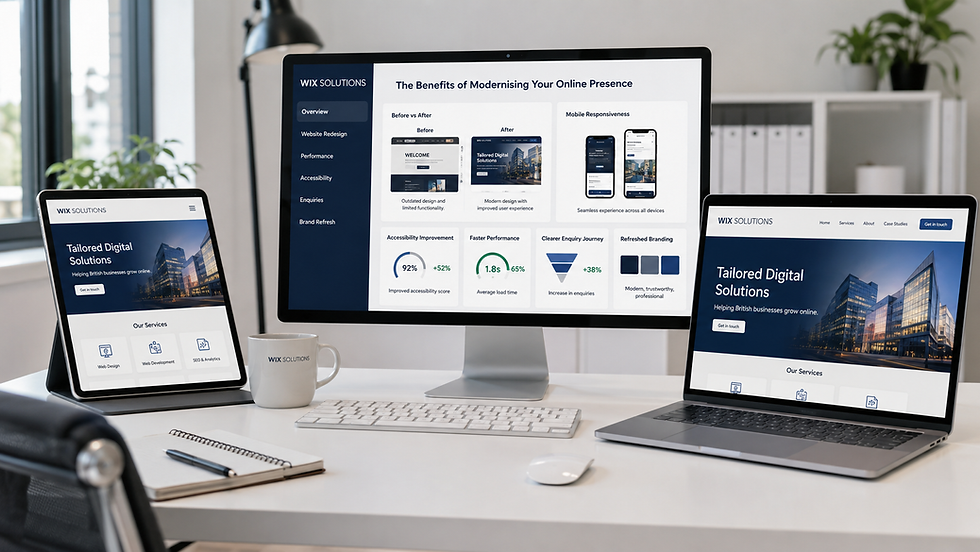
A website should not be treated as a finished brochure. It is a working part of the business: it explains value, earns trust, captures enquiries and connects customers with the next useful action. When an old site becomes slow, confusing or inconsistent with the company it represents, modernising it can improve the whole customer journey.
For UK business owners, the strongest projects are not redesigns for fashion’s sake. They are carefully planned improvements to content, accessibility, performance, measurement and operational integration. Wix Solutions brings these elements together so that a refreshed site looks credible, works reliably and remains practical for the team that manages it.
Why Your Online Presence Needs Modernising
Your online presence often shapes a prospect’s first impression before anyone speaks to your team. Modernising it means aligning what customers see with how the business now operates. That can include clearer positioning, better mobile layouts, faster media, accessible navigation, trustworthy proof, focused calls to action and integrations that reduce manual administration.
A modern site should help visitors answer four questions quickly: Am I in the right place? Can this company solve my problem? Do I trust it? What should I do next? If the answers are difficult to find, extra visual polish alone will not repair the experience.
The Business Benefits of a Modern Website
Clearer positioning: focused pages help each audience understand the service, its value and the next step.
Better mobile usability: responsive layouts, readable type and touch-friendly controls support customers on smaller screens.
Improved accessibility: logical headings, meaningful alternative text, sufficient contrast and keyboard-friendly journeys make content easier to use.
Stronger performance: appropriately sized images, cleaner page structures and disciplined apps can reduce friction.
More qualified enquiries: purposeful calls to action and better forms help visitors provide the information your team needs.
Connected operations: CRM, bookings, email automations, payments and analytics can reduce duplicate work.
More useful measurement: well-defined events reveal which pages and journeys support genuine business goals.
Scalable content: reusable sections and a clear information architecture make future updates more consistent.
Modernisation Is More Than a New Look
A visual refresh matters, but the most valuable work happens when brand, content, user experience and technology support the same commercial objective. Wix Solutions begins with the business model and the customer journey, then decides which pages, components and integrations deserve attention.
The following case studies are illustrative composites created to show how the approach can be adapted. They do not identify individual clients, and any measurements described are examples of what a business should track rather than promised results.
Case Study 1: Cybersecurity Consultancy
Situation: A specialist cybersecurity consultancy had developed new managed services, but its website still read like a technical capability list. Decision-makers could not quickly distinguish risk assessments, incident response and ongoing monitoring. The old enquiry form also treated every visitor in the same way.
Modernisation plan: Wix Solutions would restructure the site around buyer concerns, create clear service pathways and add concise explanations for non-technical stakeholders. Trust pages would bring certifications, methodologies and responsible disclosure information into a consistent framework. A short qualification form could route enquiries by organisation size, urgency and service need, while avoiding the collection of sensitive incident details.
What to measure: completion of key service journeys, qualified consultation requests, engagement with trust content and the proportion of visitors who reach the appropriate next step. The goal is not simply more traffic; it is better-informed conversations.

Case Study 2: Plumbing and Heating Company
Situation: A regional plumbing and heating company relied heavily on telephone calls. Its site mixed emergency repairs, planned installations and maintenance plans on one long page. Mobile visitors struggled to find service areas, opening hours and the right contact option.
Modernisation plan: The new experience would separate urgent and planned work, place service-area information near each call to action and introduce a mobile-first booking request. Clear expectations about response times, call-out information and the details customers should prepare would reduce avoidable back-and-forth. Structured job types could also feed the Wix CRM so office staff receive consistent information.
What to measure: completed request forms, tap-to-call actions during opening hours, abandoned form steps and the percentage of submissions containing enough detail for triage. Good modernisation supports both customers and the people answering them.

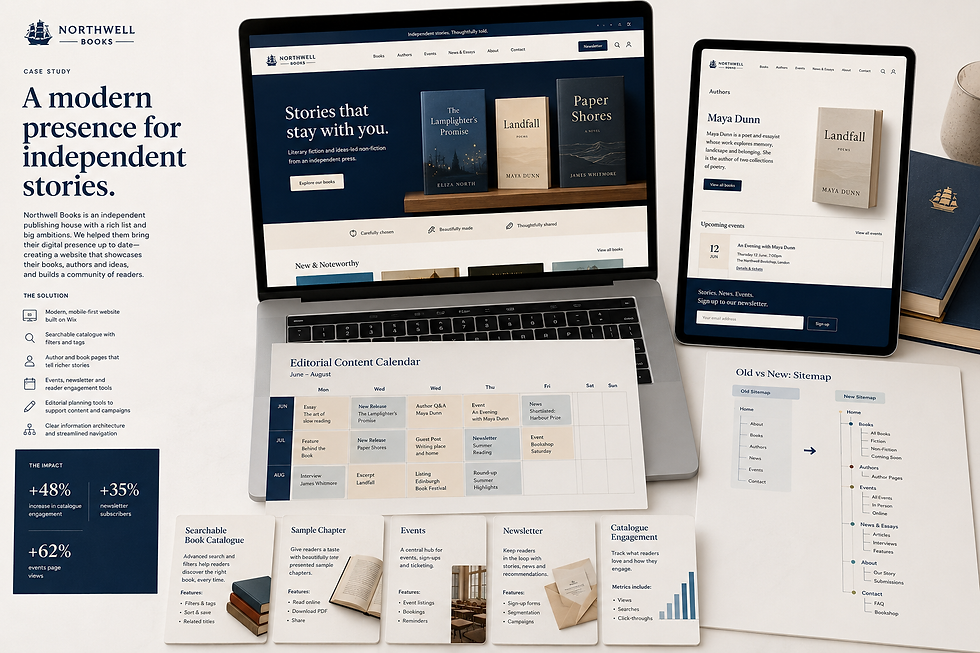
Case Study 3: Independent Publishing House
Situation: An independent publisher had a growing backlist, author events and trade information, yet the website organised content by internal departments. Readers found it difficult to browse by genre, booksellers lacked easy access to metadata and media assets, and new releases disappeared quickly from the home page.
Modernisation plan: Wix Solutions would design a searchable catalogue with consistent book pages, author profiles and related titles. Trade resources could sit in a clearly labelled area, while event and newsletter journeys would be connected to relevant books and authors. A modular editorial system would allow the small team to reuse layouts without making every page look identical.
What to measure: catalogue searches, visits from book pages to retailer or enquiry links, newsletter sign-ups by interest, event registrations and engagement with backlist titles. The modern site becomes a discoverable publishing platform rather than a temporary campaign page.
Case Study 4: Specialist Travel Consultancy
Situation: A specialist travel consultancy sold carefully planned, high-value itineraries, but its old site presented generic destination galleries. Prospects could not see the difference between a tailored consultation and a standard package, so initial enquiries often arrived without useful context.
Modernisation plan: The refreshed site would explain the planning process, show itinerary examples without implying fixed packages and use destination content to demonstrate expertise. An enquiry journey could ask about travel style, approximate dates, party needs and budget range in a respectful sequence. Authentic photography and clear consumer information would reinforce confidence without overwhelming the page.
What to measure: completion of the planning questionnaire, quality of submitted briefs, visits from destination guides to consultation pages and the time the team spends clarifying basic requirements. The website should prepare both sides for a more productive first conversation.

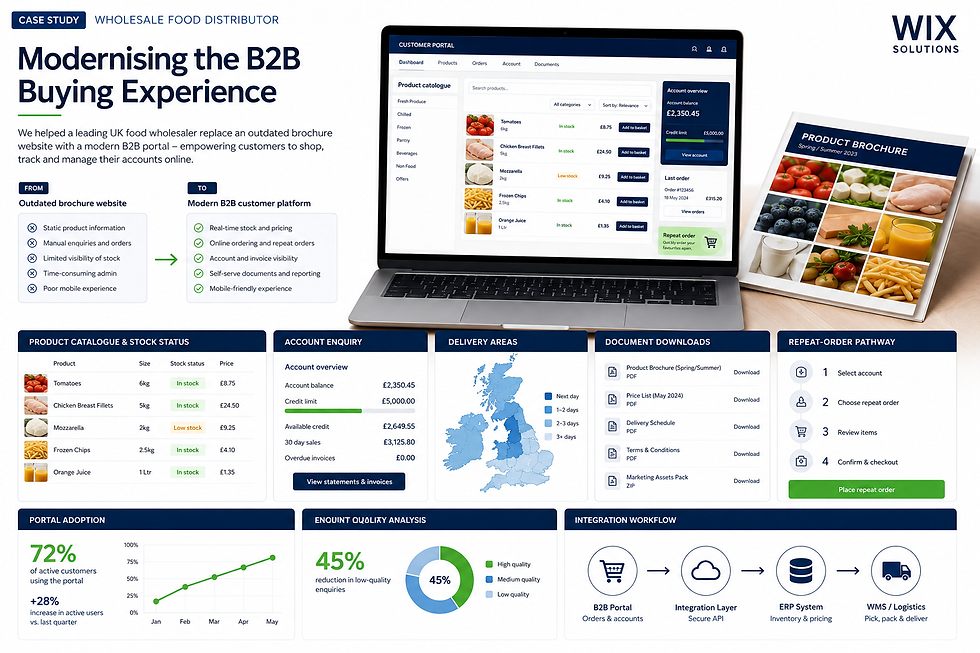
Case Study 5: Wholesale Food Distributor
Situation: A wholesale food distributor served independent retailers and caterers. Its public website contained PDFs with overlapping product lists, while account enquiries and delivery-area questions arrived through several unrelated email addresses. Buyers could not tell which ranges were current.
Modernisation plan: Wix Solutions would create structured range pages, dietary and storage filters, delivery-area guidance and an account-enquiry route suited to trade customers. Product information could be managed centrally and presented consistently, with clear ownership for updates. Where appropriate, approved customers could later gain access to account-specific resources without rebuilding the public site.
What to measure: use of range filters, trade-account applications, visits to delivery guidance, reduction in outdated documents and the time required to publish product changes. The strongest result is a dependable source of information for customers and staff.
How Wix Solutions Plans a Modernisation Project
Wix Solutions uses a phased process so that decisions remain tied to evidence and business priorities. The scope can range from improving an existing Wix website to rebuilding a more complex experience in Wix Studio.
Discover: clarify audiences, commercial goals, operational constraints and the evidence available.
Audit: review content, analytics, search visibility, accessibility, mobile behaviour, performance and integrations.
Prioritise: identify the pages and journeys with the greatest customer or operational value.
Prototype: test navigation, page structure and calls to action before committing to detailed design.
Build: create responsive components, migrate useful content and connect approved business tools.
Assure: test accessibility, forms, tracking, redirects, devices and editorial workflows.
Launch and learn: monitor agreed indicators, collect feedback and improve the site in manageable cycles.
This approach avoids changing everything at once without a reason. It also helps business owners distinguish essential launch work from sensible later phases.
When Should You Modernise?
Warning signs include an outdated visual identity, poor mobile layouts, slow or unstable pages, duplicated content, inaccessible forms, unclear service information, unreliable tracking and a publishing process that only one person understands. A change in business model, audience or service mix is another strong reason to review the website.
Modernisation does not always require a complete rebuild. A focused content and conversion project may be enough when the underlying structure is sound. When architecture, performance and administration are all limiting growth, a broader rebuild is usually more efficient than a sequence of disconnected fixes.
Why Choose Wix Solutions?
Wix Solutions combines website strategy, UX, visual design, content structure, SEO foundations and Wix implementation. That joined-up view is important because a design decision can affect accessibility, a content decision can affect search visibility, and an integration decision can affect the daily workload of the business.
For a practical foundation before modernising, read Creating an Effective Online Presence for Your Business. You can also review Key Elements Every Successful Website Should Have and explore the technical perspective in Full-Stack Website Design for London Business Owners.
Frequently Asked Questions
1. Does modernising a website always mean rebuilding it?
No. If the existing structure is stable, a business may gain more from improving content, navigation, responsive behaviour, accessibility and measurement. A rebuild is justified when the platform structure, page architecture or integrations prevent efficient improvement.
2. How often should a business review its online presence?
A light review should happen throughout the year, with a deeper audit when the business changes direction, introduces important services or sees evidence of customer friction. Regular reviews are more useful than redesigning on an arbitrary timetable.
3. Will a modern website improve search visibility immediately?
Not automatically. Search visibility depends on technical quality, relevant content, authority, competition and time. Modernisation can create a stronger foundation through better structure, performance, accessibility and internal linking, but it should not be presented as a guaranteed ranking shortcut.
4. Can Wix Solutions modernise an existing Wix website in stages?
Yes. A phased programme can begin with the highest-value pages and customer journeys, then extend to content systems, CRM automations, e-commerce, bookings or more advanced functionality. The roadmap should keep redirects, analytics and editorial continuity in view from the start.
Bibliography
Krug, Steve. Don’t Make Me Think, Revisited: A Common Sense Approach to Web Usability. 3rd edition. New Riders, 2014.
Garrett, Jesse James. The Elements of User Experience: User-Centered Design for the Web and Beyond. 2nd edition. New Riders, 2010.
Redish, Janice (Ginny). Letting Go of the Words: Writing Web Content that Works. 2nd edition. Morgan Kaufmann, 2012.
Chaffey, Dave, and Fiona Ellis-Chadwick. Digital Marketing: Strategy, Implementation and Practice. 8th edition. Pearson, 2022.
Norman, Don. The Design of Everyday Things. Revised and expanded edition. Basic Books, 2013.
A modern website should make the business easier to understand, trust and contact. Wix Solutions can help you turn that principle into a practical roadmap, a coherent design system and a website your team can confidently maintain.


