Business Website Benefits: A Practical Hampshire Guide

Updated: Feb 9, 2023
Business website benefits become clear when a site is treated as working infrastructure rather than an online brochure. A useful website helps the right people discover a business, understand the offer, judge whether it is credible and take the next sensible step. It also gives the team a stable place to publish accurate information, measure customer behaviour and improve the journey over time.
For a Hampshire business, the opportunity is not simply to mention the county repeatedly. The site should reflect the real service area, customer needs and operating model. A trades company in Fleet, a consultancy serving Southampton, an independent retailer near Winchester and a visitor attraction in the New Forest require different journeys even though all may value local visibility.

This guide explains what a website can contribute, where it fits alongside search and social platforms, how to plan it responsibly and what good implementation looks like for four common business situations. It avoids invented statistics and universal promises because the value of a website depends on the outcome it is designed to support.
Business Website Benefits Across the Customer Journey
Business Website Benefits: A Clear Source of Current Information
Customers need dependable answers: what the business does, who it is for, where it operates, what a service includes, how much it may cost and how to proceed. Social profiles and directory listings can support discovery, but they divide information across systems the business does not fully control. A website gives the organisation a central source that can be linked from those profiles and updated through an agreed editorial process.
That source only builds confidence when it stays current. Out-of-date opening times, disconnected telephone numbers, unavailable services and contradictory policies create work for customers and staff. Assign an owner to each important page, record when it was checked and include a clear route for reporting errors.
A structured route from need to action
A visitor rarely arrives wanting to admire a home page. They want to solve a problem. Navigation, page order and calls to action should therefore reflect decisions: compare services, inspect evidence, understand the process, check suitability and enquire, book or buy. The strongest route may contain fewer choices than the organisation chart suggests.
Different visitors can need different next steps. A person ready to book should not be forced through a long brand story, while someone considering a high-value service may need case material, credentials and a consultation before committing. A well-designed site supports both without scattering competing buttons across every section.
Trust built from specific evidence
Credibility comes from verifiable detail. Useful evidence may include named people, genuine project outcomes, transparent service boundaries, professional registrations, delivery steps, current policies and reviews displayed with permission and context. A polished design supports that material by making it readable and coherent; it cannot compensate for vague claims or invented authority.
Local trust also depends on accuracy. Use authentic photographs and explain the relationship with Hampshire where it is relevant. Do not imply an office, client base or partnership that does not exist. Visitors should be able to distinguish a real service area from a list of locations added for search visibility.
Customer service before the first conversation
A website can answer routine questions at any time without pretending to replace human service. Eligibility, lead times, preparation, delivery areas, accessibility, returns, cancellation and emergency contact routes can all reduce uncertainty. Good answers improve the quality of enquiries because customers arrive with a more realistic understanding of the offer.
The content should make exceptions visible. If a quoted price is a guide, say what changes it. If a booking is not confirmed until the team responds, explain that step. Automation is useful only when the wording matches the real process behind it.
Measurement that supports better decisions
A website can record which pages people reach, where a journey loses momentum and which enquiries or purchases follow a campaign. Measurement should begin with a decision rather than a dashboard. A service business might track qualified form submissions and booked calls; a retailer may track product discovery, basket progression and completed orders; a venue may track availability views and confirmed bookings.
Analytics needs a documented purpose, sensible retention and appropriate privacy controls. Under UK rules, cookies and similar technologies can require clear information and valid consent unless an exemption applies. The organisation should review the tools actually deployed rather than copy a generic banner. Legal and privacy questions deserve qualified advice for the specific setup.
Discovery: How a Website Supports Local Visibility
A verified business profile can help an eligible organisation appear on Google Search and Maps, while a website provides the deeper information behind that listing. Keep names, contact details, service areas and opening information consistent. Link to the most relevant page, not automatically to the home page, and maintain both systems when something changes.
The Hampshire SEO agency guide explains how useful local pages, consistent business information and technical foundations work together. Search visibility is earned through relevance and quality; merely owning a domain does not guarantee that a page will rank.
Pages should answer a distinct local intent. A county-wide service page may be enough when the offer is identical across Hampshire. Separate town pages make sense only when they provide genuinely different evidence, availability, logistics or customer guidance. Near-duplicate pages waste editorial effort and can create confusing journeys.
Mobile, Performance and Accessibility Are Core Requirements
Customers may use a website on a small screen, a slow connection, with keyboard navigation, screen magnification or assistive technology. Responsive layouts, readable text, visible focus, descriptive controls, logical headings and suitable alternative text are not optional decoration. The Web Content Accessibility Guidelines provide an international framework for making content more accessible to disabled people, but automated checks alone cannot confirm the whole experience.
Performance also affects ordinary use. Google's Core Web Vitals measure real-world aspects of loading, responsiveness and visual stability, but no single score describes business success. Optimise images, scripts, fonts and third-party embeds; test key templates on realistic devices; and investigate field data where available. A fast empty page is not useful, while a beautiful page that delays every action is frustrating.
Professional Wix web design across Hampshire, Surrey and Berkshire should connect responsive design, accessible content and performance with the commercial journey. These requirements belong in the brief and acceptance checks, not as repairs after launch.
Four Practical Hampshire Website Plans
Practical Example 1: A local trades business
A heating company serves a defined radius from Basingstoke. The website prioritises service categories, availability boundaries, qualifications, genuine project evidence and a form that captures the fault, postcode and preferred contact route. Emergency and routine enquiries are separated. Each confirmation explains when the team will respond, so the form does not create a false promise of an immediate booking.
Practical Example 2: A professional consultancy
A consultancy works with organisations across Hampshire and remotely. Its site explains the problems it handles, the engagement process, who does the work and what a suitable first conversation covers. Insight articles answer common questions, while case studies show outcomes without exposing confidential information. The primary call to action requests a scoped consultation rather than pushing every visitor towards an instant purchase.
Practical Example 3: An independent retailer
A shop near Winchester uses its website to show current ranges, delivery or collection options, returns, accessibility and contact details. If it sells online, product pages include accurate photography, dimensions, stock states and total-cost information. The store keeps its business profile, social channels and website hours aligned. Campaign measurement distinguishes completed orders from visits so the owner can judge whether promotion is commercially useful.
Practical Example 4: A visitor-focused venue
A small attraction near the New Forest plans for people researching before travelling. The site makes seasonal opening, directions, parking, public transport, accessibility, weather limitations, family facilities, prices and booking status easy to find. Photography reflects the real experience and is updated when facilities change. The team reviews common pre-visit questions and turns recurring answers into clearer page content.
Plan the Website Around Operations
Begin with the business model, audience and customer journeys. Inventory existing content, analytics, domains, forms, integrations and search-critical URLs. Decide which information must be maintained, by whom and how often. Define the minimum launch scope and a later improvement list so the project does not become an untestable collection of wishes.
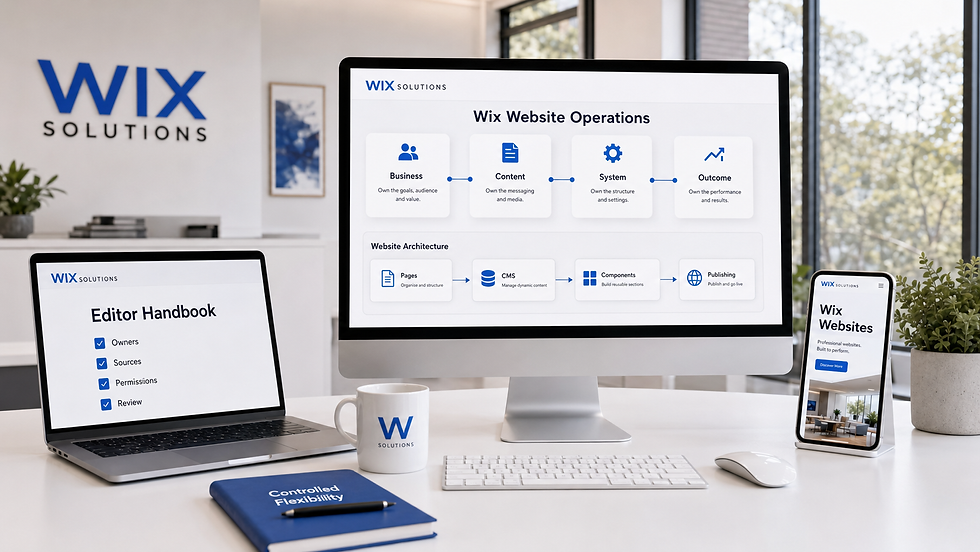
The guide to Wix websites a team can operate shows why reusable components, clear permissions and editorial rules matter. A site is sustainable when ordinary updates are safe, exceptional changes are controlled and ownership remains clear after the designer leaves.
Write acceptance checks before build. Can a visitor understand the offer on mobile? Can an editor update a service without breaking spacing? Do forms deliver and record consent correctly? Can a keyboard user complete the journey? Are error and confirmation states clear? Does the team know how to restore or escalate a problem? Launch readiness is demonstrated by those checks, not by reaching a visual deadline.
Responsible AI for Website Planning and Content
Artificial intelligence can help organise interview notes, propose information architecture, cluster frequently asked questions, create test scenarios or compare two versions of a page. It can support first drafts and consistency checks when the team supplies accurate source material. Those uses accelerate preparation, but generated content should not be published without human review.
Do not use AI to invent testimonials, awards, prices, office locations, professional credentials, performance results or local knowledge. Do not paste customer records, unpublished contracts, passwords or confidential analytics exports into an unapproved service. Health, financial, legal and safety claims require appropriately qualified review. Images should not misrepresent premises, people or completed work.
A named editor should verify facts, tone, permissions, accessibility and the final call to action. Record important sources and review dates. AI can suggest an alternative description or heading, but it cannot decide whether the business can fulfil the promise on the page.
What to Measure After Launch
Check the basics first: uptime, broken links, form delivery, booking or checkout completion and indexing of important pages. Then review qualified actions, not raw traffic alone. Compare conversion by landing page and device, read search queries, listen to customer questions and watch whether staff still need to explain something the site should make clear.
Use a regular improvement cycle. Fix failures, clarify high-friction content, test one meaningful change and document the result. Retire pages that no longer serve a purpose or redirect them carefully when another page replaces the intent. Maintain accessibility, privacy and performance as content and integrations evolve.
Wix Solutions provides professional Wix website design for businesses that need a customer-focused build with a manageable editing system. The scope should reflect evidence from discovery rather than a fixed bundle of pages.
Conclusion
The strongest business website benefits are practical: clearer information, more confident decisions, better-qualified enquiries, usable customer journeys and evidence for improvement. A website does not replace excellent service, local reputation, search profiles or human relationships. It connects them through a dependable experience the organisation can maintain.
Explore the wider range of website, content and growth services if the project also involves brand, search or ongoing content. If you are planning a new Hampshire business website or repairing an existing journey, contact Wix Solutions with the audience, current platform and most important customer action.