How Consultants Help Businesses Grow

Growth problems rarely arrive with tidy labels. A business may describe a marketing problem when the deeper issue is an unclear offer, slow sales follow-up, unreliable delivery or weak margin information. It may ask for a new system when roles and decisions have not yet been defined. Consultants help separate symptoms from causes and turn a broad ambition into a manageable programme of work.
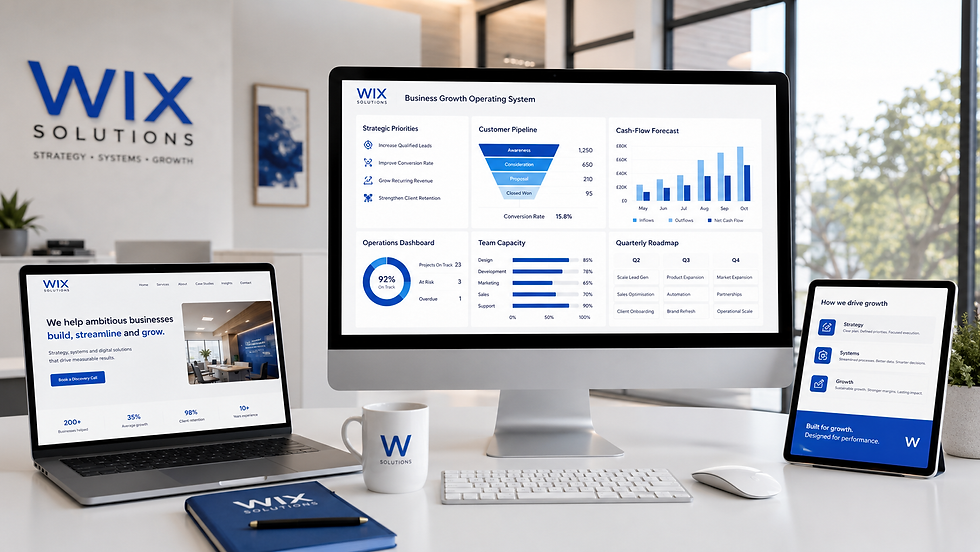
Wix Solutions approaches consulting as a practical partnership. We connect business strategy, customer journeys, operations, digital systems and measurement so recommendations can be implemented—not simply presented. The purpose is to help owners and teams make better decisions with clearer evidence.
Consultants create value through focus and independent challenge
Consultants are useful because they can look across functions without being tied to one department’s assumptions. They bring patterns from other organisations, structured methods and the capacity to investigate a problem that the existing team may be too busy to examine. Independence matters, but it is valuable only when combined with listening and respect for local knowledge.
A strong adviser does not arrive with a predetermined answer. The first task is to establish what is true: how customers actually buy, where work waits, what the numbers show, what employees know and which constraints are structural. This diagnosis gives the business a common language for difficult choices.

What business consultants actually do
Frame the problem: convert a broad concern into specific questions, boundaries and desired outcomes.
Establish a baseline: map current performance, customer journeys, processes, costs, capacity and risks.
Test assumptions: combine data, interviews, observation and market evidence rather than accepting the first explanation.
Prioritise: distinguish urgent stabilisation from important capability-building and optional improvements.
Design options: compare trade-offs, dependencies, investment, risk and likely operational impact.
Support implementation: define milestones, owners, governance, communications and measures.
Transfer capability: leave templates, methods, documentation and confidence with the internal team.
This work may lead to a commercial plan, operating model, customer-experience redesign, digital roadmap, process improvement or management rhythm. The form should follow the problem. A new website, CRM or automation can be part of the answer, but technology should not be used to avoid a decision about the business itself.
The consulting cycle: diagnose, decide, deliver and learn
1. Diagnose the constraint
Start with evidence. Review financial and operational data, speak with the people doing the work, listen to customers and observe where information or decisions wait. Separate causes from consequences. A falling conversion rate, for example, may reflect poor lead quality, unclear qualification, slow response or an offer that is difficult to compare.
2. Decide what not to do
Growth creates more possible initiatives than any team can execute well. Consultants help leaders compare opportunities against strategy, capacity, cash, risk and customer value. A useful priority list is short enough to fund, staff and review. Every chosen initiative should have a named owner and every deferred initiative should be consciously deferred.
3. Deliver in measurable stages
Recommendations become valuable when translated into work. Break the change into testable stages, define decisions and dependencies, and make progress visible. Early stages may stabilise cash or service quality; later stages can automate, scale or expand. This protects the business from a large transformation whose benefits arrive too late to validate.
4. Learn and transfer ownership
Consultants should make themselves less necessary over time. Reviews must capture what changed, what the evidence says and what the team will do next. Documentation, training and governance are not administrative extras; they are how the business retains value after the engagement.
For a broader diagnostic framework, read Strategies for Navigating Business Challenges. Owners planning long-term expansion can also use Top Strategies for Growing a Thriving Business.
Five illustrative consulting case studies
The following cases are fictional teaching scenarios. Company names, people, data and results shown in the visuals are illustrative; they are not client claims or guarantees. Each case comes from a different industry and demonstrates a distinct consulting problem.
Case study 1: Regional logistics company — profitable growth before expansion
A regional logistics company wanted to enter two new sectors, but its service levels and margin varied by route and customer type. The consulting work began with a route map, customer segmentation, utilisation trends and a consistent definition of contribution margin. The team discovered that network balance and empty miles mattered more than headline revenue.
Instead of expanding immediately, the business tested scheduling changes, revised onboarding and built a capacity dashboard. Scenario planning compared core growth, a new sector and network optimisation. The lesson is important: consultants help a business distinguish more activity from better economics, then sequence investment around the real constraint.

Case study 2: Sustainable fashion wholesaler — reduce risk while protecting margin
A sustainable fashion wholesaler had grown across markets, but supplier risk, ageing stock and inconsistent forecasting made cash requirements difficult to predict. Consultants brought purchasing, sales and finance into one planning process. They mapped supplier exposure, stock age, buyer segments and six-month order scenarios.
The result was not a single forecast presented as certainty. It was a decision system: assumptions were visible, ranges were compared and responsibilities for reviewing evidence were assigned. The company could discuss margin, stock and provenance together instead of allowing each function to optimise its own target.

Case study 3: Construction firm — improve enquiry quality and delivery focus
A construction and fit-out firm received many enquiries, but project information was incomplete and senior staff spent too much time deciding which opportunities deserved attention. The consulting engagement mapped the journey from first visit to tender review and defined qualification criteria that reflected sector, project type, location, timing and fit.
The website and internal process were then redesigned together. A structured portfolio helped prospects self-select, while a clear enquiry route gathered the information required for a timely response. The important change was not simply a better form; it was agreement about which work the firm wanted to win and how decisions would be made.

Case study 4: Community charity — make services easier to find and govern
A community charity had accumulated programmes, events and resources over several years. People found it difficult to locate the right support, volunteers could not see appropriate opportunities and staff lacked a consistent process for publishing or reviewing information.
Consultants facilitated workshops with service teams and community representatives, then mapped tasks rather than internal departments. The work covered information architecture, accessibility, safeguarding, privacy, content ownership and multilingual needs. Growth in this context meant serving people more reliably—not maximising transactions. The consulting method adapted the measures to the mission.

Case study 5: Craft brewery — align brand, channels and commercial choices
A craft brewery had loyal local customers but inconsistent presentation across packaging, its taproom, retail partners and online sales. The question was not merely how to refresh the logo. Consultants examined customer recognition, route-to-market priorities, product range, digital journeys and the operational cost of maintaining multiple variants.
The business developed a coherent visual system and clear rules for packaging, social content and online collections. Commercial measures sat alongside creative review so brand decisions could support shelf recognition, repeat purchase and manageable production. Consultants helped creative, sales and operations make one set of choices rather than three disconnected plans.

How to commission consulting work well
The quality of an engagement depends partly on the brief. A vague instruction to grow the business encourages vague activity. Define the decision or constraint, the scope, the evidence available, the people who must be involved and the outcome the business wants to improve. State what cannot change as well as what can.
Name an internal sponsor with authority to resolve conflicts and make decisions.
Give the consultant access to the people and data needed to test assumptions.
Agree deliverables, milestones and decision points rather than only a final report date.
Define how recommendations will be evaluated, resourced and implemented.
Protect space for candid discussion; employees must be able to describe problems without fear.
Set expectations for documentation, training and handover from the beginning.
The consultant should explain the method, limitations and evidence. Beware of impressive dashboards that hide weak definitions, recommendations detached from capacity or projected outcomes presented as guaranteed. Good consulting makes uncertainty more manageable; it does not pretend uncertainty has disappeared.
If you are deciding whether external support fits your situation, compare this guide with How Business Consulting Can Help You Grow for a complementary view of strategy, operations and staged implementation.
Choosing the right engagement model
A short diagnostic is useful when the problem is unclear. A focused project suits a defined issue such as lead qualification, process redesign or digital planning. Ongoing advisory support can help leadership teams review decisions and maintain momentum, while embedded implementation is appropriate when specialist capacity is temporarily missing.
No model is automatically best. Match the arrangement to the decision cadence, internal capability and risk. If the business cannot name who will own the work, pause before commissioning it. External expertise cannot substitute for internal accountability.
Measuring consulting value without oversimplifying it
Agree a baseline before recommendations change the system. Measures might include qualified enquiry rate, gross margin, order cycle time, capacity utilisation, response time, stock age, error rate, service access or management hours released. Include unintended effects: a faster process that increases errors is not an improvement.
Review leading and lagging indicators together. Training completed or a dashboard launched shows activity; better decisions and sustained performance show impact. Some value is risk avoided or capability gained, so combine quantitative measures with evidence of stronger routines, clearer ownership and faster learning.
Frequently asked questions
When should a business hire consultants?
External support is most useful when the business faces a defined decision or constraint, lacks specialist capacity, needs an impartial diagnosis or must coordinate change across several functions. The brief should still have a clear owner inside the business.
What should a good consulting engagement deliver?
It should deliver more than a report: a shared diagnosis, explicit priorities, decisions, an implementation plan, measures, named owners and knowledge transferred to the internal team. The scope and evidence should be visible throughout the engagement.
How can a business measure consulting value?
Agree a baseline before work begins and track a small set of outcomes linked to the problem, such as qualified enquiries, margin, cycle time, capacity, error rate, cash conversion or customer retention. Include the cost and effort of implementation, not only the consultant's fee.
Do consultants replace employees?
Usually no. Consultants provide temporary focus, specialist methods or independent challenge. Employees hold operational knowledge and sustain the change. The strongest engagements combine both and leave the internal team more capable than before.
Conclusion
Consultants help businesses grow by creating clarity where ambitions, evidence and operations have become disconnected. Their best contribution is not an imported answer. It is a disciplined process that helps the organisation see the constraint, make explicit choices, implement them in stages and learn faster.
Wix Solutions combines business consulting with digital strategy, content, design and implementation. That joined-up perspective helps owners avoid isolated fixes and build systems their teams can understand, manage and improve.
Bibliography
Maister, David H.; Green, Charles H.; Galford, Robert M. The Trusted Advisor. 20th Anniversary Edition.
Rumelt, Richard. Good Strategy/Bad Strategy: The Difference and Why It Matters. 1st edition.
Newton, Richard. The Management Consultant: Mastering the Art of Consultancy. 2nd edition.
Goldratt, Eliyahu M.; Cox, Jeff. The Goal: A Process of Ongoing Improvement. 3rd revised edition.
Doerr, John. Measure What Matters: How Google, Bono, and the Gates Foundation Rock the World with OKRs. 1st edition.
Senge, Peter M. The Fifth Discipline: The Art & Practice of the Learning Organization. Revised and updated edition.