Top Strategies for Growing a Thriving Business

A thriving business is not simply one that becomes larger. It is a business that creates genuine customer value, generates enough cash to meet its commitments, develops capable people and adapts without losing control of quality. Growth is useful when the operating model can support it; otherwise, more demand can magnify weak processes, poor margins and exhausted teams.
For UK business owners, the practical challenge is to connect strategy with day-to-day decisions. Wix Solutions helps businesses clarify their market, improve the digital customer journey, organise information and build systems that support measured growth. The website is one part of that system, alongside finance, operations, people and governance.
What Does a Thriving Business Look Like?
A thriving business understands who it serves, why customers choose it and how value is delivered profitably. It can distinguish productive growth from activity that consumes resources without strengthening the organisation. It also has enough visibility to spot problems early.
Clear direction: a small number of priorities translates into choices about customers, services, investment and time.
Customer value: products and services solve defined problems, and feedback influences improvement.
Financial control: cash flow, margin, working capital and investment are reviewed alongside revenue.
Operational capability: processes, capacity and quality can support demand without depending on constant firefighting.
Capable people: roles, decisions, skills and development match the work the business needs to perform.
Useful technology: tools remove friction, improve information and support the operating model.
Resilience: risks, dependencies and scenarios are considered before they become emergencies.
Learning: the business measures outcomes, tests assumptions and adjusts without changing direction every week.
1. Choose a Focused Market Position
Growth becomes difficult when a business tries to serve every possible customer. Define the priority segments, their needs, buying process, alternatives and the capabilities required to serve them well. A focused position does not prevent future expansion; it provides a base from which expansion can be evaluated.
Use customer interviews, enquiry patterns, lost-sale reasons, competitor analysis and market data to test assumptions. Avoid treating a large theoretical market as proof of demand. The relevant question is whether the business can reach, win and serve a valuable segment with a credible advantage.
2. Turn Strategy into Measurable Priorities
A strategy should lead to decisions, not just an annual document. Select a small number of outcomes for the next quarter, define the owner, set an indicator and state what will not be prioritised. Review progress often enough to act, but not so often that the organisation chases random variation.
A useful priority might be ‘improve the quality and speed of qualified quotations’ rather than ‘grow sales’. The first can shape process, capacity, information and website changes; the second is too broad to guide work.
3. Protect Cash Flow and Margin
Revenue can grow while cash weakens. Forecast expected receipts, payments, payroll, tax and investment using realistic timing. Review gross margin by service, customer segment or product family where possible. Understand the cash consequences of longer payment terms, inventory, recruitment and capital expenditure before committing.
Scenario planning is more useful than pretending one forecast will be exact. Compare a reasonable base case with slower demand, delayed payments, cost increases and capacity constraints. Financial decisions should be reviewed with an appropriately qualified accountant or adviser.
4. Improve the Customer Journey
Map the journey from first awareness to enquiry, purchase, delivery, support and renewal. Identify where customers wait, repeat information, misunderstand the offer or struggle to choose. Improvements may involve clearer web content, better forms, service standards, CRM stages, onboarding and proactive communication.
Customer experience is not a promise owned only by marketing. It is the result of design, operations, policies and people working together. Measure enquiries and conversions, but also suitability, complaints, resolution, retention and the questions customers repeatedly ask.
5. Standardise Before You Automate
Document important processes at the level needed for reliable work. Clarify inputs, decisions, responsibilities, exceptions and the information that must be retained. Standardisation should protect quality without preventing judgement.
Automation can then remove repetitive administration, connect approved systems and make status visible. Automating a confused process usually makes confusion faster. Begin with the customer and staff problem, then select technology that supports the solution.
6. Build Capacity Before Demand Breaks It
Capacity is more than headcount. It includes skill, equipment, supplier availability, management attention and process constraints. Use a simple view of current demand, available capacity and expected changes. Identify the point at which quality or lead time begins to deteriorate.
Recruitment is one option, but not the only one. Better scheduling, service design, training, supplier arrangements, pricing, self-service information and elimination of low-value work may create capacity more quickly.
7. Develop People and Decision Ownership
Growth can overload founders and senior managers when every decision returns to them. Define roles, decision boundaries, escalation points and the information teams need. Development should support the future operating model rather than provide training without application.
A healthy culture does not mean avoiding accountability. It means expectations are understandable, feedback is timely, people can raise risks and good work is repeatable. Monitor workload, capability gaps and the concentration of essential knowledge in one person.
8. Use a Balanced Growth Dashboard
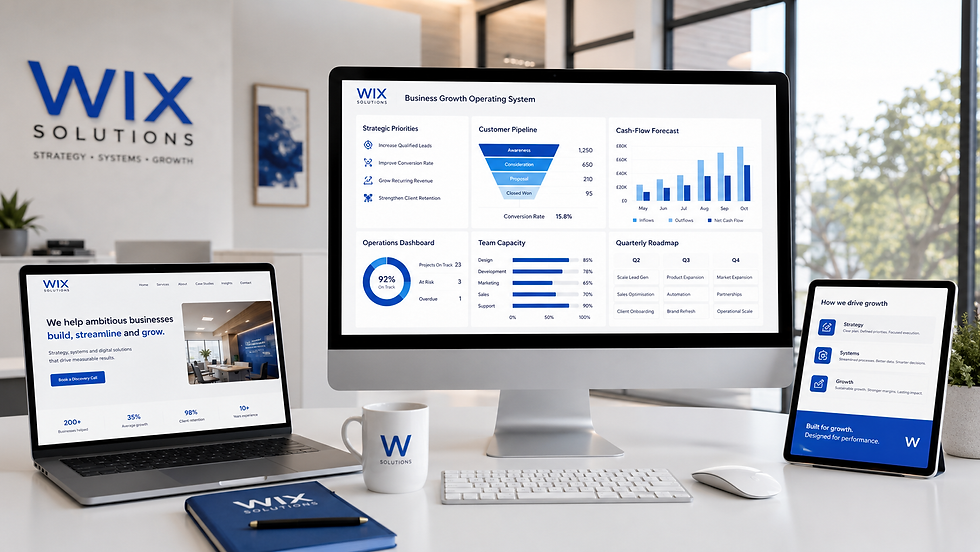
A dashboard should help a team decide, not create a performance theatre. Combine leading and lagging indicators across customers, finance, operations and people. A short list might include qualified pipeline, conversion, gross margin, cash forecast, delivery performance, capacity, retention and critical skills.
Define each measure, source, owner and review frequency. Numbers without consistent definitions create debate rather than insight. Pair data with customer feedback and operational observation.
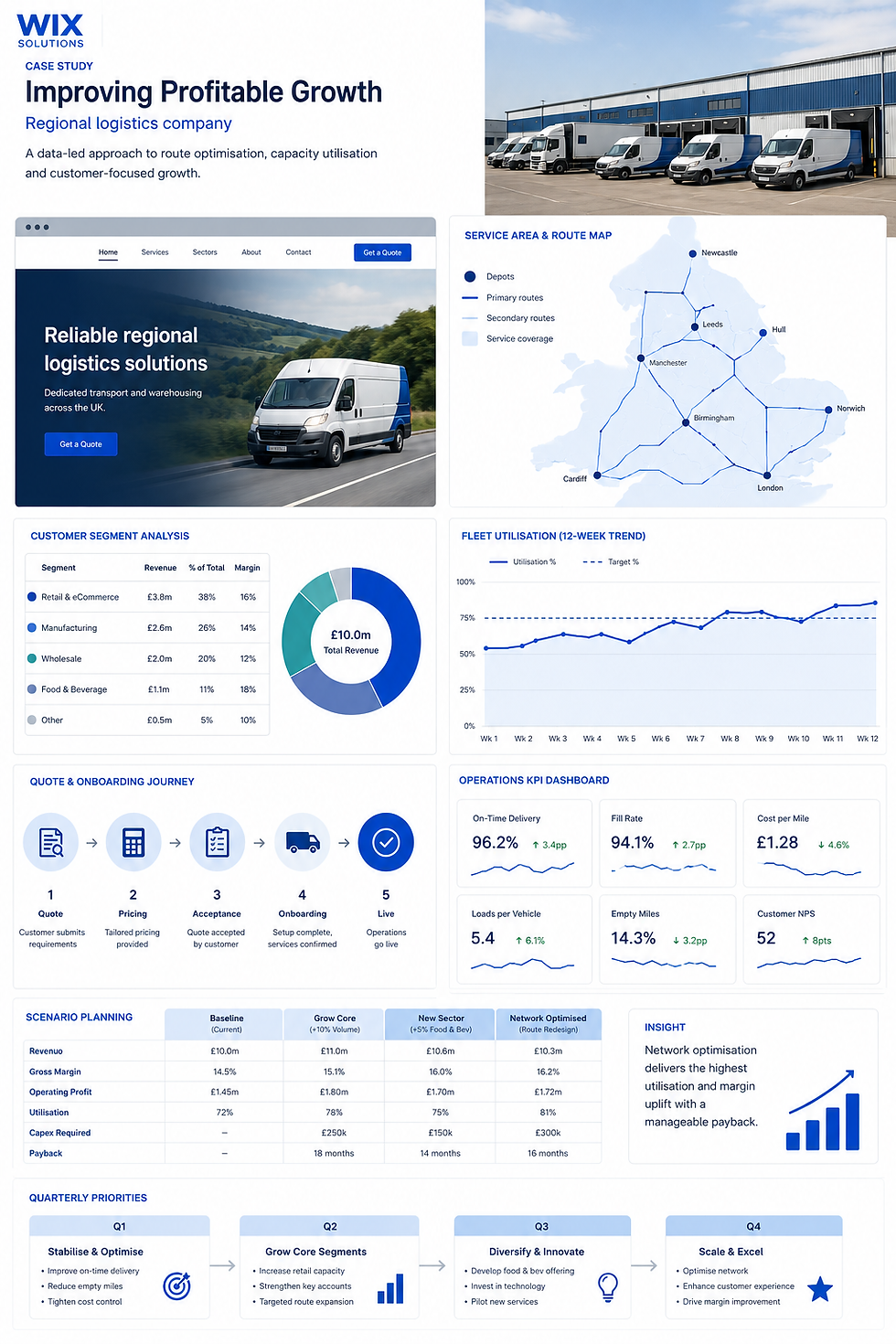
The five case studies below are illustrative composites. Business names, endorsements, financial values and performance figures shown in the images are fictional examples created to demonstrate planning and measurement; they are not Wix Solutions client results or forecasts.
Case Study 1: Precision-Engineering Manufacturer
Situation: A precision-engineering company wanted to grow in higher-value sectors. Enquiries were increasing, but quotation effort was spread across opportunities with very different technical fit. Capacity information sat in separate spreadsheets, and a small number of specialists carried essential knowledge.
Growth strategy: Wix Solutions would support a clearer digital proposition by market and application, while the management team scored segments against attractiveness and capability. The enquiry-to-quote process would introduce early technical qualification. Capacity planning, quality requirements and a skills matrix would inform which opportunities the business could serve reliably. Automation candidates would be prioritised by business impact and feasibility rather than novelty.
What to measure: qualified opportunity value, quote cycle time, win rate by segment, utilisation at the constraint, first-time quality, delivery reliability, margin and skills coverage. Growth should strengthen capability and customer fit, not merely increase machine hours.

Case Study 2: Regional Logistics Company
Situation: A regional logistics provider had added customers and vehicles, yet margins varied sharply by route and service pattern. Sales focused on volume, while operations dealt with empty miles, uneven depot capacity and customer requirements discovered too late.
Growth strategy: The company would define priority segments, standardise quote information and connect website enquiries to a structured onboarding process. Route and depot data would inform service-area decisions. Scenario planning would compare growth in core lanes with new-sector or network-investment options, including the cash and operational demands of each.
What to measure: contribution by customer and route, fleet utilisation, empty miles, delivery performance, claims, quote quality, payment timing and customer retention. The most attractive growth uses the network more intelligently rather than expanding it automatically.
Case Study 3: Independent Insurance Broker
Situation: An independent insurance broker relied on referrals and long-standing relationships. The business wanted to grow, but customer knowledge sat with individual advisers and marketing activity was inconsistent. Any expansion also needed to respect regulatory responsibilities.
Growth strategy: The brokerage would define customer segments and service needs, improve the website’s educational structure and create a compliant content-approval process. Referral sources and enquiry qualification would be documented without pressuring unsuitable prospects. Renewal milestones, responsibilities and risk controls would be visible across the team. Compliance questions would remain with qualified professionals.
What to measure: suitable enquiries, referral sources, time to first response, renewal activity, customer retention, complaints, adviser capacity and concentrations of client or key-person risk. Resilience and service quality are part of growth.

Case Study 4: Landscaping and Grounds-Maintenance Company
Situation: A landscaping business experienced strong seasonal demand, but one-off projects, recurring maintenance and route planning competed for the same crews. Quotes were produced inconsistently, and the website did not make service areas or contract options clear.
Growth strategy: Wix Solutions would organise the website by customer need and service type, then connect quote requests to a consistent site-visit and scheduling workflow. A seasonal service calendar and route map would support capacity decisions. The company could evaluate recurring contracts based on customer value, delivery cost and cash timing rather than assuming all recurring revenue is equally attractive.
What to measure: quote conversion, route density, crew utilisation, schedule changes, gross margin by service, contract retention, seasonality and cash forecast. A thriving service business protects standards and workload as its portfolio grows.

Case Study 5: Workforce-Planning Software Company
Situation: A workforce-planning software company was winning customers in several segments, but onboarding effort and support needs varied. The product roadmap contained requests from sales, existing customers and internal teams without a shared prioritisation method.
Growth strategy: The business would refine its ideal-customer profile, document the acquisition and onboarding journey, and connect product, customer-success and support feedback. Roadmap decisions would consider customer value, strategic fit, implementation effort and risk. Unit economics and cohort behaviour would be reviewed by segment rather than averaged across the entire customer base.
What to measure: qualified pipeline, activation, time to first value, support demand, adoption of key workflows, retention by cohort, cost to acquire and serve, cash runway and team capacity. Responsible scaling means aligning commercial demand, product capability and service capacity.

How Wix Solutions Supports Business Growth
Wix Solutions focuses on the digital and operational connections that influence the customer journey: positioning, website structure, content, forms, CRM stages, automations, analytics and practical decision dashboards. The work should complement—not replace—qualified financial, legal, regulatory or sector-specific advice.
A growth engagement can begin with a focused audit, an improved website journey or a phased transformation roadmap. The right scope depends on the business model, evidence available, team capacity and risks.
A 90-Day Growth Review
Days 1–30: define the priority market, customer problem, baseline measures, cash outlook and main operational constraint.
Days 31–60: improve one high-value customer journey, standardise its process and test whether information flows reliably.
Days 61–90: review commercial quality, capacity, cash, customer feedback and team workload; select the next priority based on evidence.
Questions to Ask Before Investing
Which customer problem and segment does this investment serve?
What evidence suggests demand is valuable and reachable?
What cash is required before the benefit arrives?
Which process, skill, supplier or system could become the constraint?
How will quality, customer experience and risk be protected?
Which indicators would cause us to continue, adjust or stop?
Who owns the decision and the follow-through?
Related Wix Solutions Guides
For a deeper look at structured advisory work, read How Business Consulting Can Help You Grow. To strengthen the digital foundation, continue with The Benefits of Modernizing Your Online Presence. For customer participation and distribution, see How to Build a Strong Social Media Presence for Your Brand.
Frequently Asked Questions
1. What is the most important strategy for business growth?
Clear focus is the foundation. A business must understand the customer segment, problem, value and capability it will prioritise. Other investments—marketing, technology, recruitment and automation—become easier to judge once that direction is clear.
2. How can a business grow without harming cash flow?
Use realistic cash forecasting, staged commitments, margin analysis and scenario planning. Review the timing of receipts and payments, not only projected revenue. Significant financial decisions should be assessed with a qualified accountant or adviser.
3. When should a small business automate a process?
Automate after the process, responsibilities, exceptions and required information are understood. Start where repetitive work creates clear customer or operational friction. Test the change and retain appropriate human review for judgement, safety, regulation or sensitive decisions.
4. Can Wix Solutions provide business consulting and website support together?
Wix Solutions can connect business objectives with positioning, website design, content, CRM, automations and measurement. Where a decision requires regulated financial, legal or specialist advice, the business should also use an appropriately qualified professional.
Bibliography
Rumelt, Richard P. Good Strategy/Bad Strategy: The Difference and Why It Matters. 1st edition. Crown Business, 2011.
Osterwalder, Alexander, and Yves Pigneur. Business Model Generation: A Handbook for Visionaries, Game Changers, and Challengers. 1st edition. Wiley, 2010.
Kaplan, Robert S., and David P. Norton. The Balanced Scorecard: Translating Strategy into Action. 1st edition. Harvard Business School Press, 1996.
Goldratt, Eliyahu M., and Jeff Cox. The Goal: A Process of Ongoing Improvement. 3rd revised edition. North River Press, 2004.
Ries, Eric. The Lean Startup: How Today’s Entrepreneurs Use Continuous Innovation to Create Radically Successful Businesses. 1st edition. Crown Business, 2011.
Kim, W. Chan, and Renée Mauborgne. Blue Ocean Strategy: How to Create Uncontested Market Space and Make the Competition Irrelevant. Expanded edition. Harvard Business Review Press, 2015.
A thriving business grows with purpose, evidence and control. Wix Solutions can help you turn those principles into a clearer digital proposition, a better customer journey and practical systems that support sustainable progress.