
Social Media Marketing: Build Global Reach Without Losing Local Meaning

A post can cross borders in seconds, but commercial reach is not the same as market readiness. People may see the message and still be unable to understand the offer, trust the evidence, pay in an expected way, receive the service or obtain support.
Social Media Marketing creates global opportunity when distribution is connected to local meaning and operational reality. The work includes audience research, language, format, cultural context, destination pages, fulfilment, customer service and measurement. Without those connections, reach becomes a large number attached to a weak journey.
This guide develops a practical international framework without relying on unstable platform statistics. It uses four composite social-media cases to show where global expansion succeeds, stalls or creates avoidable risk.
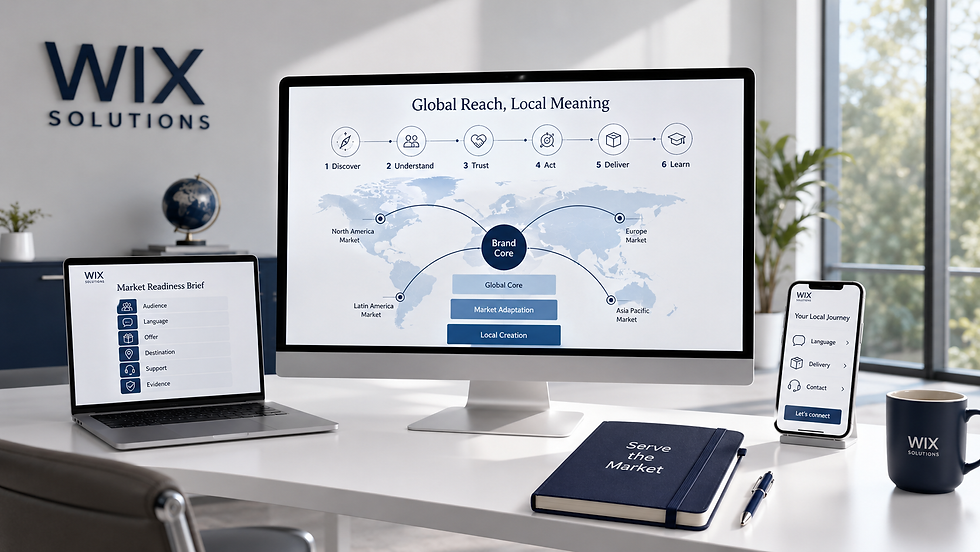
Social Media Marketing turns global reach into a market journey
Global reach begins with visibility but continues through relevance, trust, action and delivery. A strategy should therefore define which markets can be served, what evidence each audience requires and what happens after interest.
The meaningful unit of global growth is not an impression. It is a supported customer journey in a market the business can serve responsibly.
Social Media Marketing has six layers of reach
Availability. The account, content and linked destination can be accessed in the market.
Discoverability. Language, topics, creators, communities and paid distribution connect the message with a relevant audience.
Meaning. The proposition, examples, tone and format make sense within the audience’s context.
Trust. Evidence, policies, contact, delivery and support reduce uncertainty.
Action. The destination supports the expected language, currency, form, booking or purchase path.
Delivery. The organisation can fulfil the promise and handle service across location, time zone and language.
A campaign should not be launched into a market that fails the final layers simply because the first two are easy to buy.
Choose markets by serviceability, not audience size
Start with evidence of fit: existing enquiries, customers, search demand, partner knowledge, language capability, delivery coverage and competitive context. A smaller market that the organisation understands may offer a stronger learning environment than a large audience with no supported journey.
A market-readiness brief
Priority audience, problem and current alternative.
Offer, price logic and what can genuinely be delivered.
Language and level of adaptation required.
Local evidence, partners or specialist review.
Payment, delivery, booking or eligibility constraints.
Customer-service route, hours and escalation.
Destination pages, forms and confirmation.
Permissions, claims, platform and sector considerations.
Measurement and a clear pause condition.
Use the Social Media Branding & Marketing service to connect distribution with brand, content and commercial operations.
Separate the core promise from local expression
A global brand needs a stable centre: purpose, audience problem, offer logic, evidence standards, visual recognition and behavioural principles. Local work adapts language, examples, timing, format, response and sometimes the route to action.
Consistency should protect truth and recognition, not force every market into the same sentence. If a term has no natural equivalent, rewrite the meaning rather than preserving an awkward literal translation.
Use three levels of content
Global core. Positioning, approved claims, identity, essential product or service facts and evidence standards.
Market adaptation. Language, examples, cultural references, creators, calendar, format, objections and calls to action.
Local creation. Community conversations, events, customer stories and opportunities that originate in the market.
Define who can change each level and how learning returns to the shared system. Local teams need authority within clear evidence and brand boundaries.
Review Translation Strategies: Make Social Media Travel Without Losing Meaning and Translation & Multilingual Content.
Build a destination for the market
A translated social post linked to a generic English homepage is not a multilingual journey. The destination should continue the audience, problem, promise, evidence and action established in the post.
A market-specific landing page may need language, territory, price assumptions, delivery, availability, contact, form fields and confirmation appropriate to that market. It should be genuinely useful rather than a duplicated page with a place name inserted.
Keep campaign and website facts synchronised
Service names, product availability, prices, delivery areas, dates and policies need maintained sources. If a social campaign changes faster than the website, customers encounter contradictory promises at the point of commitment.
The guide Local Landing Pages: A Conversion Guide for Hampshire Businesses is local in subject but useful for understanding how a destination should reflect a real audience and offer rather than act as a keyword shell.
Choose an international operating model
Central control can protect evidence and identity but may miss local language and timing. Full local autonomy can create relevance but also contradictory claims and duplicated effort. Most organisations need a designed relationship between the two.
Central responsibilities
Positioning, offer boundaries and brand system.
Approved product or service facts and evidence.
Shared content sources and reusable assets.
Permissions, escalation and high-consequence review.
Cross-market measurement and learning.
Access, security and account continuity.
Local responsibilities
Audience language, context and community insight.
Translation, adaptation and cultural review.
Market calendar, creators and conversation.
Local response and service handover.
Evidence of objections, demand and operational gaps.
Recommendations for shared content and offer improvement.
A short weekly operating rhythm can align upcoming content, market changes, customer questions, service issues and experiments. The output should update sources, not only the calendar.
Use creators and partners as interpreters, not rented reach
A relevant creator or market partner can provide trust, language and community knowledge. Evaluate fit through audience relationship, subject competence, communication style, disclosure, production quality and willingness to represent the offer accurately.
Provide a clear brief with purpose, non-negotiable facts, prohibited claims, permissions, destination, review boundaries and customer-service route. Leave room for the creator’s real voice; a scripted imitation weakens the value of the partnership.
Plan what happens after publication
Decide who answers comments, handles private questions, supplies product or service detail and escalates complaints. A collaboration can expose operational gaps more quickly than the brand’s usual content because the creator’s audience asks from a different context.
Paid distribution amplifies readiness and weakness
Paid social can test audiences and messages, but it also scales misunderstanding. Before increasing distribution, check destination relevance, delivery, availability, language, support and confirmation.
Use small, clearly framed tests to compare propositions, evidence and destinations. Do not interpret a cheap click as proof of market demand. Review the quality of the visit, action, enquiry and service consequence.
Avoid the universal creative fallacy
One piece of creative may perform differently because language, prior knowledge, visual conventions, season and platform use vary. Preserve the strategic idea while testing locally appropriate expression. Document what changed so learning can be compared.
Measure market progress as a sequence
Report each layer separately so a distribution success cannot hide a delivery failure.
Attention. Relevant reach, viewing and content interaction within the intended market.
Understanding. Questions, saves, useful responses and the language audiences use.
Intent. Qualified visits to the intended market destination.
Action. Enquiries, bookings, registrations, purchases or applications that match the offer.
Quality. Suitability, conversion progression, repeated questions and support burden.
Delivery. Fulfilment, cancellations, returns, complaints and service themes.
Learning. Changes made to content, destination, offer or operations.
Compare markets carefully. Different price levels, sales cycles, consent choices and channels can make the same metric mean something different. Use a common decision framework without pretending every market behaves identically.
Four composite global social-media case studies
The following cases combine common patterns. They are illustrative, not claims about named clients, and contain no fabricated performance figures.
Case study 1: the B2B software firm translating too early
A British software company translated product announcements for several European markets but kept the destination, demo form and onboarding entirely in English. Interest appeared, yet questions revealed that buyers could not assess implementation or support.
The team selected one priority market, adapted the proposition around a specific use case, added local-language evaluation content and made support expectations explicit. Sales and product specialists reviewed recurring questions before further expansion.
The lesson was that translation generated access, while the supported evaluation journey created market readiness.
Case study 2: the maker brand with unavailable delivery
A small e-commerce brand received enthusiastic international sharing after a product video. Its shop accepted visits from countries it could not serve economically, while social replies improvised different delivery promises.
The business defined delivery markets, created a clear availability page and adjusted calls to action by territory. Unsupported demand was captured as research rather than forced into a poor customer experience.
The lesson was that viral attention can expose operational limits. Responsible growth makes those limits visible.
Case study 3: the education provider using one calendar
An online education provider promoted the same content and event times globally. Examples, academic cycles and live-session hours suited its home market but created friction elsewhere.
The team separated evergreen learning content from market calendars, tested regionally relevant examples and published session expectations by time zone. Local questions were added to the shared curriculum and FAQ source.
The lesson was that localisation includes timing, prior knowledge and learning context—not words alone.
Case study 4: the charity and the global appeal
A charity planned a global appeal using one emotional story. Local partners warned that the framing simplified the community’s role and that response routes were unsuitable for people seeking help.
The campaign introduced consent records, partner review, distinct routes for donors and service users, and translated safeguarding guidance. Market teams could adapt examples while core facts and permissions remained controlled.
The lesson was that global visibility increases ethical responsibility. The people represented by the campaign are not merely creative assets.
Explore the Wix Solutions case studies for further examples of structured digital work.
A global social-media launch workflow
Select the market. Use evidence of fit, existing demand, serviceability and organisational capacity.
Define the supported journey. Map attention, meaning, trust, action, delivery and support.
Research the audience. Study language, problems, alternatives, creators, communities and common objections.
Separate core and local. Document fixed facts and the elements that can be adapted or created locally.
Prepare the destination. Align language, offer, evidence, action, confirmation and service route.
Design governance. Assign central and local ownership, permissions, response and escalation.
Test modestly. Compare messages and journeys without treating early attention as proof of scale.
Review quality. Assess enquiries, sales progression, delivery, support and learning by market.
Scale or pause. Increase investment only when the full journey works; pause when operations or trust cannot support demand.
Social Media Marketing market checklist
The offer can be delivered and supported in the target market.
Language and cultural review cover message, examples and response.
Claims, permissions and evidence are accurate for the audience.
The linked page continues the same market, promise and action.
Price, delivery, booking, payment or eligibility conditions are clear.
A trained owner can respond in the relevant language and time zone.
Creators or partners have briefs, disclosure and escalation routes.
Measurement includes action, quality, delivery and learning—not reach alone.
Questions and answers
Can a small business use social media to reach global markets?
Yes, but it should start with a market it can understand and serve. A focused supported journey is stronger than broad exposure across unsupported countries.
Should content be translated for every market?
Translate and adapt when there is a strategic audience, maintained destination and response capability. More languages create more publishing and service responsibility.
Is one global social account better than local accounts?
It depends on audience overlap, language, volume, local conversation, governance and team capacity. The operating model should determine account structure, not convention alone.
How can cultural mistakes be reduced?
Use local specialists or partners, document core and adaptable elements, test with representative audiences and create an escalation route. Avoid asking literal translation to perform cultural judgement.
What metric best represents global reach?
No single metric is sufficient. Review relevant attention, qualified visits, supported actions, customer quality, delivery outcomes and market learning as a sequence.
When should a business pause expansion?
Pause when fulfilment, support, claims, permissions, destination quality or service consistency cannot meet the expectations created by the campaign.
Reach further by becoming more specific
Global social marketing works when the brand is clear enough to remain recognisable and flexible enough to respect local meaning. The task is not to make one message travel unchanged. It is to build a supported path from attention to a real customer outcome.
If your international reach is growing faster than your market journey, contact Wix Solutions. We can help connect social strategy, multilingual content, destination pages and operational handovers.
Bibliography
Hollensen, Svend. Global Marketing. 8th edition, 2020.
de Mooij, Marieke. Global Marketing and Advertising: Understanding Cultural Paradoxes. 5th edition, 2019.
Usunier, Jean-Claude, and Lee, Julie Anne. Marketing Across Cultures. 7th edition, 2013.
Jenkins, Henry; Ford, Sam; and Green, Joshua. Spreadable Media: Creating Value and Meaning in a Networked Culture. 1st edition, 2013.
Baym, Nancy K. Personal Connections in the Digital Age. 2nd edition, 2015.


