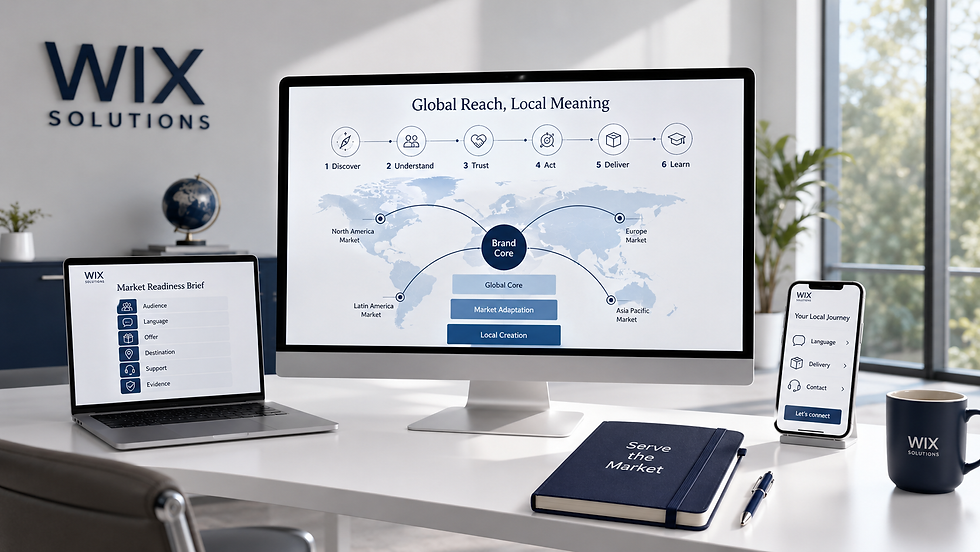
Translation Strategies: Make Social Media Travel Without Losing Meaning

A translated post can be grammatically correct and socially wrong. The joke lands as an insult, the call to action asks for an unavailable service, the subtitles cover interface controls or the image carries a symbol with a different meaning in the target market.
Translation Strategies for social media must carry intent, not only words. They coordinate language, culture, format, timing, community response and the destination that follows the click.
The useful unit is the market experience. A person should encounter a message that feels written for the context, take an action that actually exists and receive a response in the language the brand has promised.

Translation Strategies begin with market intent
Before translating, define why the content is entering the market. Is the objective awareness, education, recruitment, community, event attendance, product consideration or customer support? The answer changes terminology, tone, proof and call to action.
Write a market brief for each audience: language and regional variant, customer segment, channel behaviour, cultural context, offer availability, support capability, risks and approval owner. Do not treat a language as one uniform market. Spanish for Spain and Spanish for Mexico may require different wording, references and actions.
Meaning: What must the audience understand or feel after the post?
Action: Which next step is genuinely available in that market and language?
Evidence: Which examples, people or claims are credible and permitted?
Format: How do people use this channel, script and content type?
Response: Who can answer comments and messages accurately in the promised language?
Wix Solutions provides Translation & Multilingual Content and Social Media Branding & Marketing support so the language, visuals and wider customer journey can be planned together.
Choose translation, localisation or transcreation
Translation transfers meaning between languages. Localisation adapts the content to a particular market, including terminology, formats, references, availability and user expectations. Transcreation gives greater creative freedom to reproduce the intended effect when a headline, joke or campaign concept cannot travel directly.
Not every post needs transcreation. Product specifications, policy information and service facts often need controlled, faithful translation with specialist review. A campaign hook may need transcreation. A customer-support reply may require speed, accuracy and escalation rather than a creative rewrite.
Label the required treatment in the brief. This avoids two failures: over-adapting a statement that must remain precise, and translating a creative idea so literally that it no longer works.
Build terminology and voice before volume
A multilingual content operation needs a glossary. Record brand names, products, services, technical terms, preferred translations, prohibited translations, capitalisation and words that remain untranslated. Add context and examples; a word list without meaning can create confident errors.
Create voice guidance for each market. The brand identity should remain recognisable, but formality, directness, humour and sentence rhythm may change. Give translators examples of approved posts, audience research and the commercial intent.
Maintain a decision log. When a term changes, update the glossary and connected website content. If each campaign solves the same terminology problem again, the operation is paying for inconsistency.
The editorial principles in Content Writing: The Conversion Layer in Canadian Web Services also apply here: page or post job, evidence, action and ownership should be explicit.
Design visuals that can cross languages
Text expansion can break a graphic that was designed around a short English phrase. Script direction, word length, line height and punctuation affect composition. Build flexible templates with generous text areas, safe zones and editable live layers.
Avoid placing essential meaning only inside an image. Supply captions, subtitles and accessible descriptions in the target language. Check whether colours, gestures, clothing, maps, dates, numbers and symbols carry unintended meanings.
The image itself may need localisation. A generic stock group does not prove market relevance. Use real local evidence when available and permitted, or choose imagery whose role is clearly atmospheric rather than representative.
For practical reusable assets, review Business Graphics Design and Image Editing & Website Visuals.
Subtitle and adapt video as an experience
Start with an accurate source transcript. Translation from unclear audio creates avoidable errors. Mark speaker names, technical terms, on-screen text, humour, timing and material that should not be translated.
Subtitles need reading time, line discipline, contrast and safe placement. Review them on the actual platform and device; interface elements can cover text. Translate captions, on-screen graphics and calls to action as part of one package.
Dubbing or voice-over may suit longer educational or promotional content, but lip movement, pace and tone need judgement. A silent-friendly edit with clear visual sequencing and subtitles can work well across social feeds.
Never assume automated output is publication-ready for brand, legal, medical, financial or safety-sensitive material. The organisation remains responsible for accuracy, rights, privacy and claims.
Localise the action and destination
A translated post should not lead to an untranslated page, unavailable product or form that cannot be answered in the same language. Map every post to a maintained destination and service process.
Adapt currency, date, time, delivery, contact channels and eligibility where relevant. If the offer differs, say so before the click. Use language-specific tracking parameters and landing pages so results can be interpreted by market.
A translated call to action should describe the real commitment. “Book a consultation” is misleading if no adviser can serve the language. “Request information in French” may be accurate and more trustworthy.
Design multilingual community management
Publishing creates a promise of participation. Define who monitors comments, messages and mentions; which response templates are approved; what needs specialist escalation; and how quickly the team can respond.
Machine translation may help an internal team understand a low-risk comment, but public replies need appropriate review. Sarcasm, slang, dialect and conflict can be misread. Sensitive issues should move to a secure private channel without exposing personal data.
Record recurring questions by language. They reveal missing content, local objections and terminology. Community management is a research function, not only a response queue.
Three social-media translation cases
These composite examples are illustrative social-media cases. They are not named-client claims or invented performance figures.
Case study 1: a UK–France design launch on Instagram
A furniture brand translated English captions into French but kept the phrase “small-space living” as a literal campaign hook. French reviewers found it functional but emotionally flat. The team transcreated the central idea around adaptable urban homes while keeping product facts exact.
Templates were widened for French text and carousel cards linked to a complete French collection page. The lesson: product truth needed translation; campaign feeling needed transcreation.
Case study 2: a Polish–English trades campaign on Facebook
A home-services group used one bilingual image with dense text and two phone numbers. Mobile users could not identify which service or language applied. The campaign was rebuilt as separate language variants with the same visual system, local service-area details and language-specific contact routes.
Community managers used an approved terminology guide and escalated technical questions. The lesson: separation improved clarity without fragmenting the brand.
Case study 3: an international software brand on LinkedIn and short-form video
The software company launched feature posts in five markets from one English master. Direct translation created inconsistent product terms, and subtitles collided with the mobile interface. A central glossary, source transcript and platform-safe subtitle template were introduced.
Local reviewers could adapt examples while locked product claims remained unchanged. The lesson: multilingual speed came from governed source content and review roles, not skipping judgement.
Related reading: Social Media Marketing: Build a Brand People Remember, How Social Media Marketing Impacts Global Reach and Boost Your Social Media Engagement with Effective Strategies. Explore our case studies for wider content and brand work.
A multilingual publishing workflow
Brief the market. Define audience, intent, channel, offer, risks, owner and available response.
Prepare the source. Remove ambiguity, verify claims, supply context, transcript and editable assets.
Choose the treatment. Mark content for faithful translation, localisation or transcreation.
Use the language system. Apply approved glossary, voice, examples and locked terminology.
Adapt the creative. Check text fit, imagery, subtitles, symbols and platform safe zones.
Review in context. Use a qualified reviewer and inspect the actual post, device and destination.
Publish with coverage. Confirm community-management and escalation capacity.
Learn by market. Measure relevant actions and feed questions back into the glossary, website and next brief.
Translation Strategies publishing checklist
The target market, language variant, audience and commercial intent are explicit.
Translation, localisation or transcreation is selected by content risk and purpose.
Terminology, product names, voice and prohibited translations are documented.
Visual templates accommodate text length, script direction and mobile safe zones.
Captions, subtitles, on-screen text and alternative descriptions use the target language.
Dates, currency, delivery, eligibility and calls to action match the market.
The linked page and service process support the same language promise.
A reviewer checks meaning, culture, claims, rights and actual platform presentation.
Community owners can respond and escalate in the published language.
Results and questions are reviewed separately by market, not hidden in one global total.
Questions and answers
Is machine translation suitable for social media?
It can support drafting or understanding in low-risk contexts, but publication quality depends on language pair, subject, brand voice and risk. Human review is essential where accuracy, reputation, rights or customer action matters.
What is transcreation?
Transcreation recreates the intended effect of creative content in a target language and culture. It may change wording, examples or metaphor while protecting the campaign objective and approved facts.
Should one account publish several languages?
It depends on audience overlap, channel behaviour, volume and community capacity. One account can work with clear labelling and balanced content; separate accounts may suit distinct markets. Choose based on experience and maintenance, not convention alone.
Do hashtags need translation?
Research actual market usage. A literal translation may be unused, ambiguous or owned by an unrelated conversation. Use hashtags only when they help discovery or context.
How should multilingual social results be compared?
Compare each market against its objective, audience size, channel maturity, spend and available offer. Raw engagement rates across unlike markets can mislead.
Who should approve translated posts?
A qualified language reviewer should check meaning and tone; the service owner should verify facts and availability; brand or legal specialists should review sensitive claims where required. Assign one final publishing owner.
Make the promise portable
Good multilingual social media feels locally intelligent and globally recognisable. That outcome comes from briefs, language assets, flexible design, real destinations and responsive community management.
If your social content, graphics and Wix website need a coordinated multilingual system, contact Wix Solutions or explore our services.
Bibliography
Munday, Jeremy; Pinto, Sara Ramos; and Blakesley, Jacob. Introducing Translation Studies: Theories and Applications. 5th edition, 2022.
Esselink, Bert. A Practical Guide to Localization. 1st edition, 2000.
Handley, Ann. Everybody Writes: Your New and Improved Go-To Guide to Creating Ridiculously Good Content. 2nd edition, 2022.
De Mooij, Marieke. Global Marketing and Advertising: Understanding Cultural Paradoxes. 5th edition, 2019.