How Social Media Impacts Modern Business Growth

Social media can support modern business growth, but only when it is connected to a clear commercial purpose. Posting frequently is not a strategy in itself. A useful social presence helps the right people discover a business, understand its value, trust its expertise and take a sensible next step—whether that is visiting a website, making an enquiry, booking an appointment or returning to buy again.
For UK business owners, the strongest approach treats social platforms as one part of a joined-up customer journey. The website remains the owned destination; social content earns attention and starts conversations; email, customer relationship management and analytics help the business follow through. Wix Solutions brings these parts together so that creative work is supported by practical measurement, accessible design and reliable digital systems.
How Social Media Influences Business Growth
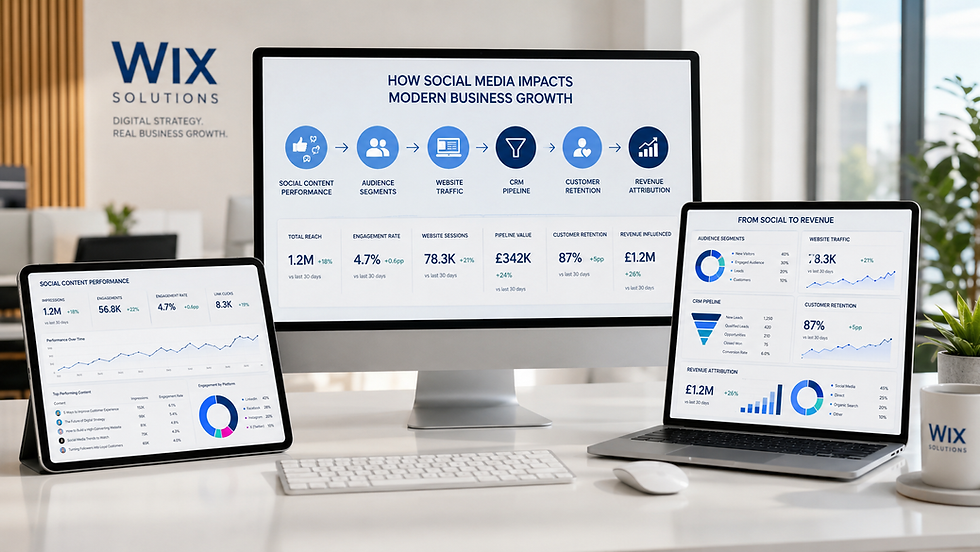
Social media influences business growth through several connected mechanisms. It can expand discovery beyond existing customers, demonstrate expertise before a sales conversation, provide fast feedback on demand and make a brand easier to remember. It can also strengthen recruitment, partnerships and customer retention. None of these outcomes is automatic: each depends on relevance, consistency, credible proof and a clear route from attention to action.
A useful way to think about social media is as a bridge between the market and the business. On one side are real questions, preferences, objections and conversations. On the other are the company’s services, website, sales process and customer experience. Good strategy carries useful information in both directions. It helps customers make decisions while giving the business evidence about what the market values.
Seven ways social media can contribute to sustainable growth
Discovery: searchable, shareable content introduces the business to people who may not know its name.
Trust: useful explanations, process transparency and credible customer proof reduce uncertainty.
Demand generation: relevant calls to action move interested people towards a landing page, enquiry or booking.
Customer insight: questions, comments, saves and website behaviour reveal topics that deserve investment.
Retention: helpful follow-up content keeps the business useful after the first purchase.
Reputation: visible, timely responses show how the organisation communicates and solves problems.
Recruitment and partnerships: a clear point of view helps potential employees and collaborators understand the business.
The important distinction is between platform activity and business value. Reach may indicate that content is being distributed, but reach alone does not pay wages or build loyalty. A business should connect social indicators with website sessions, qualified enquiries, sales, repeat custom and customer feedback. The correct measures depend on the commercial objective.
Build the strategy around the customer journey
Begin with the decision a customer is trying to make. A recruitment candidate wants to judge whether a role and employer are credible. A fitness customer wants to know whether a class feels welcoming and fits their schedule. A farm-shop customer may care about provenance, seasonality and opening times. Content should answer those real questions before asking for a conversion.
Wix Solutions recommends mapping four stages: discovery, evaluation, action and retention. At discovery, content should be clear enough to stop the right person without relying on vague trends. During evaluation, the website should offer detail, proof and reassurance. At action, forms, booking tools or e-commerce should be simple and mobile-friendly. During retention, email and social content can continue to educate and invite customers back.
For a practical companion to this framework, read How to Build a Strong Social Media Presence for Your Brand. It explains how positioning, profiles, content and measurement should work together.
Choose channels by behaviour, not fashion
A platform is useful when the intended audience uses it for a relevant behaviour and the business can sustain the required standard. A visually led studio may benefit from portfolio content. A professional service may earn attention through concise analysis and informed commentary. A local repair network may gain more from practical problem-prevention content and location-specific updates than from polished entertainment.
The channel decision should also consider ownership and risk. Social platforms can change formats, distribution and account access. Build valuable content on the website as well, capture consented first-party data where appropriate and avoid making a single platform the only route to customers. This makes the digital presence more resilient.
Create a content system instead of chasing a rigid ratio
Fixed posting formulas can sound reassuring, but they rarely reflect the buying cycle, industry or capacity of a real business. A more useful content system balances four jobs: educate, prove, connect and convert. The balance can change during a launch, a seasonal peak or a quieter period.
Educate with answers, demonstrations, comparisons and practical guidance.
Prove with case studies, reviews, credentials, process detail and finished work.
Connect with people, values, behind-the-scenes context and genuine conversation.
Convert with relevant invitations to enquire, book, visit, subscribe or buy.
Every post does not need a direct sales message. It does need a reason to exist. A content brief should state the intended audience, the question being answered, the evidence available, the format, the next step and the measure that will indicate usefulness.
Measure the path from attention to commercial value
Use platform analytics to understand distribution and interaction, but verify what happens afterwards. Campaign links, website analytics, form sources, booking data and customer relationship management records can show whether social activity attracts the right visitors. Qualitative evidence matters too: sales teams may hear better-informed questions, customers may mention a useful guide, and support teams may see fewer repeated queries.
Useful measures include qualified website sessions, completed enquiries, booking starts and completions, email sign-ups, assisted conversions, repeat purchases and response time. Save rate or video completion can help diagnose content quality, but neither should be mistaken for revenue. Review the smallest set of measures that can inform the next decision.
Illustrative case studies: five different growth journeys
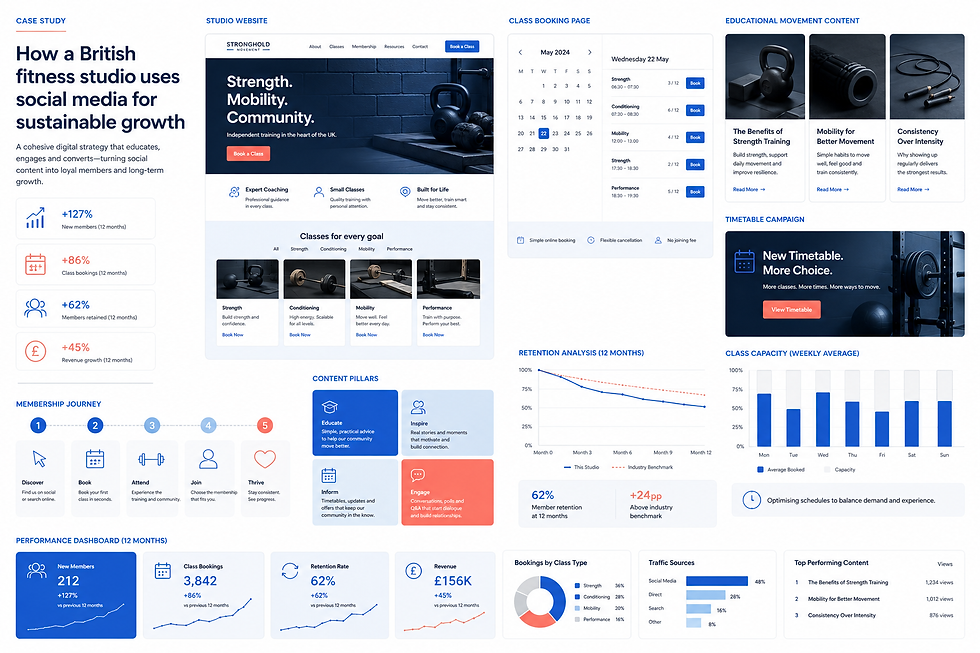
The following case studies are fictional composites created to demonstrate strategy. Business names, dashboards, charts and figures shown in the graphics are illustrative only; they are not claims about Wix Solutions clients or guaranteed results. Each scenario shows a different way social media could support an evidence-led customer journey.
Case study 1: A specialist recruitment consultancy
Situation: A regional consultancy had strong employer relationships but inconsistent candidate visibility. Its feed relied on vacancy announcements, so potential candidates had little reason to follow between job searches.
Approach: The consultancy organised content around role preparation, salary-context explainers, employer stories and recruiter Q&As. Topic-specific landing pages added depth, while tracked links connected posts with job alerts and candidate registration. Replies were handled by named consultants, giving the brand an informed and human voice.
What to measure: Candidate registrations that meet role criteria, completed job-alert subscriptions, employer enquiries, landing-page engagement and the proportion of applicants who arrive prepared.

Case study 2: An independent fitness studio
Situation: A neighbourhood fitness studio attracted trial customers but struggled to communicate its welcoming atmosphere and convert interest into repeat attendance.
Approach: Short coach demonstrations, member-friendly class explanations and realistic first-visit guides reduced uncertainty. Each campaign linked to a focused timetable and booking page. The studio followed new members with useful recovery and habit-building content rather than repeating promotional offers.
What to measure: Class-page visits, trial bookings, booking completion, second-visit rate, membership enquiries and the topics that prompt practical questions.
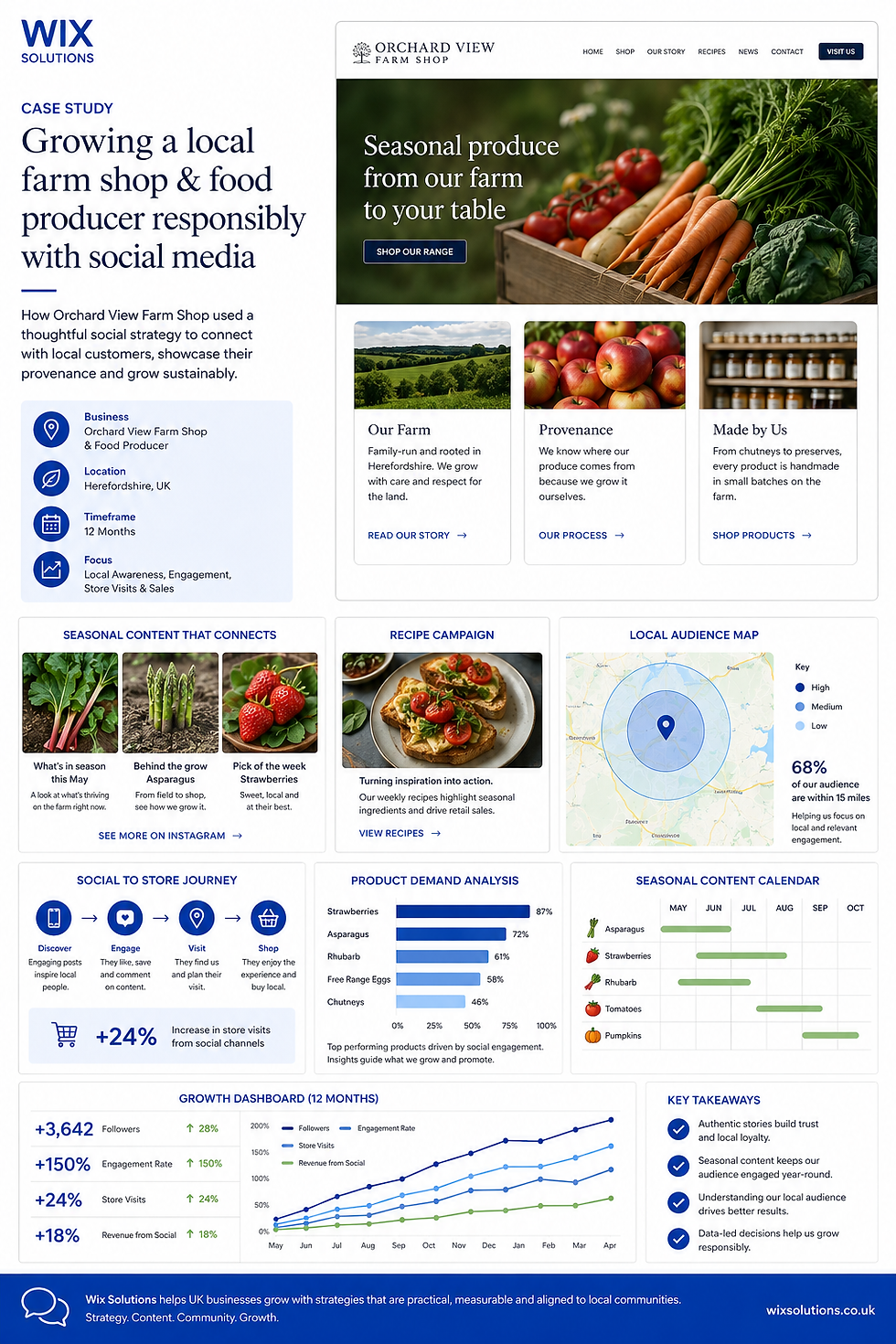
Case study 3: A farm shop and small food producer
Situation: A family-run farm shop depended on passing trade and seasonal peaks. Customers valued local produce but did not always know what was available or why it was different from supermarket alternatives.
Approach: Seasonal field updates, provenance stories, recipe ideas and producer profiles turned availability into a useful narrative. Location pages, current opening information and product collections helped nearby followers plan a visit. The content calendar followed the growing cycle, not generic awareness days.
What to measure: Directions requests, visits to opening-hours and product pages, in-store mentions, recipe saves, newsletter sign-ups and sales of featured seasonal lines.
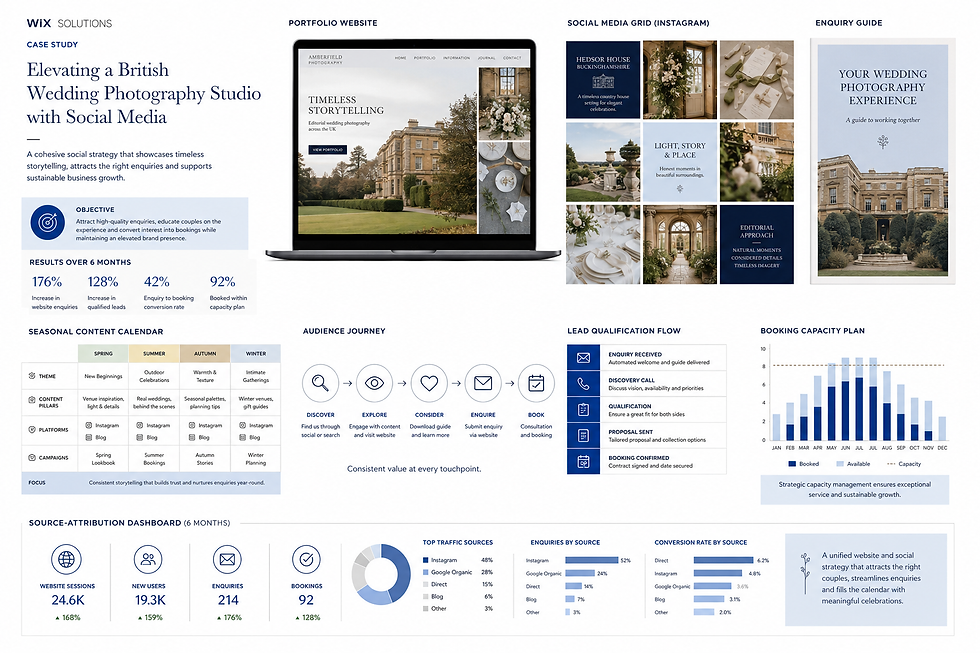
Case study 4: A wedding photography studio
Situation: A photography studio produced beautiful work but its social grid did not explain the service, planning process or difference between casual interest and a suitable enquiry.
Approach: The studio created coherent venue stories, planning guidance, complete-gallery explanations and a downloadable enquiry guide. Social posts introduced the aesthetic; the portfolio website provided full stories, transparent process information and a structured enquiry form. Capacity was considered before campaigns were expanded.
What to measure: Portfolio visits, guide downloads, qualified enquiries, enquiry-to-consultation progression, booking lead time and demand by season.
Case study 5: A domestic appliance repair network
Situation: A repair network served several towns, but customers often discovered it only after an appliance failed. Its service areas and booking process were not consistently explained.
Approach: Fault-prevention tips, technician knowledge cards and service-area updates created useful local visibility. Urgent and standard enquiries were separated, while a simple booking journey collected appliance, fault and postcode details. After service, customers received maintenance guidance and a considered review invitation.
What to measure: Qualified bookings by service area, booking completion, urgent-response time, repeat custom, review quality and demand patterns by appliance and season.

What the five examples have in common
The industries differ, but the operating principles are consistent. Each business starts with customer uncertainty, creates content that resolves it and directs interested people to an owned digital experience. Each measures a real action rather than treating popularity as the final result. The strategy also respects capacity: growth that overwhelms delivery can damage customer experience and reputation.
This is where website design, content and business operations meet. Social media may create the first touchpoint, but the outcome depends on the clarity of the page, the reliability of the form or booking tool, the speed of follow-up and the quality of the service delivered.
A practical 90-day implementation plan
Weeks 1–2: define one priority audience, one commercial objective and the customer questions that affect the decision.
Weeks 3–4: audit profiles, website landing pages, forms, analytics and consent; repair broken steps before increasing reach.
Weeks 5–6: create a small content library across education, proof, connection and conversion.
Weeks 7–8: publish consistently, respond to useful signals and record recurring questions from customers and staff.
Weeks 9–10: compare content indicators with website and enquiry quality; improve calls to action and landing-page continuity.
Weeks 11–12: document what worked, stop low-value activity and plan the next cycle around evidence and operational capacity.
For additional ideas about turning attention into meaningful action, see Top Approaches to Drive Engagement Online. For the wider commercial context, read Top Strategies for Growing a Thriving Business.
Frequently asked questions
How often should a business post on social media?
Post at a pace the business can sustain without reducing quality or response standards. Consistency matters, but the correct frequency depends on the platform, audience, content resources and objective. Start with a manageable schedule, then adjust using evidence.
Which social media platform is best for business growth?
There is no universally best platform. Choose the channel where the intended audience performs a relevant behaviour and where the business can provide distinctive, useful content. Review whether the platform produces suitable website visits, enquiries or customer conversations.
Should every social media post include a sales call to action?
No. Educational, proof-led and community content can build trust without asking for an immediate sale. When a next step is relevant, make it specific and proportionate—for example, read a guide, check availability, join a list or request a consultation.
How long does it take to see results from social media?
Early indicators such as profile visits, saves and website sessions can appear quickly, while dependable commercial patterns usually require a longer observation period. The timeframe depends on the buying cycle, starting position, offer, content quality, follow-up and available demand.
How Wix Solutions connects social media with business growth
Wix Solutions helps UK businesses connect brand positioning, social content, website design, search visibility, analytics and customer journeys. We begin with the commercial problem, identify where customers lose confidence or momentum, and build a practical system that can be managed after launch.
The result is not simply more content. It is a clearer route from discovery to trust, action and retention—supported by an accessible, responsive website and a measurement plan that helps owners make better decisions.
Bibliography
Chaffey, Dave and Ellis-Chadwick, Fiona. Digital Marketing: Strategy, Implementation and Practice. 8th edition. Pearson, 2022.
Tuten, Tracy L. Social Media Marketing. 5th edition. SAGE Publications, 2023.
Berger, Jonah. Contagious: Why Things Catch On. Revised edition. Simon & Schuster, 2016.
Kotler, Philip, Kartajaya, Hermawan and Setiawan, Iwan. Marketing 5.0: Technology for Humanity. 1st edition. Wiley, 2021.
Pulizzi, Joe. Epic Content Marketing. 2nd edition. McGraw Hill, 2023.