Social Media Presence: Building a Cohesive Online Brand

A strong social media presence is not created by posting more often. It is created when your website, social channels, visual identity, messages and calls to action feel like parts of the same business. When those elements work together, people can recognise the brand faster, understand what it offers and move from a social post to a useful next step without friction.
For Wix Solutions, the practical goal is cohesion: social content should support the wider digital system rather than operate as a separate marketing island. That means connecting social activity with website services and content, strengthening brand recognition and giving every campaign a clear commercial purpose.

Why a Social Media Presence Needs One Brand System
Customers rarely experience a business in one place. A prospect may first see a short video, search the company name, visit the website, read a service page, return to LinkedIn or Instagram and only then make contact. A cohesive social media presence reduces uncertainty across that journey because the tone, visual language and promise remain recognisable.
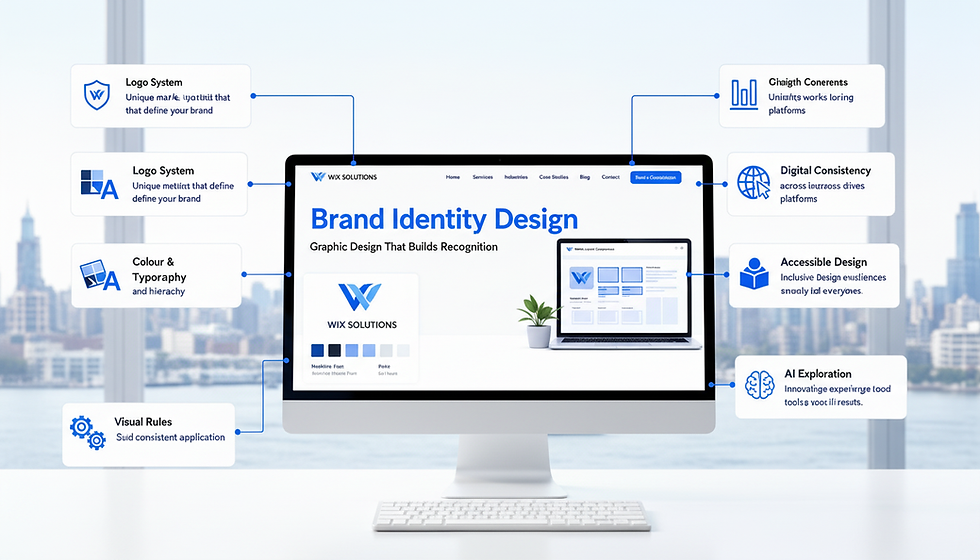
Start with a compact brand system: approved logo use, colour palette, typography, image style, writing tone, core messages and rules for calls to action. The same principles that make brand identity effective on a website should guide social templates, video covers, graphics and campaign assets. Consistency does not mean every post looks identical; it means every post belongs to the same visual and verbal family.
Build Your Social Media Presence Around the Customer Journey
Social Media Presence Example: A Professional Services Firm
A consultancy might use LinkedIn for insight-led posts, short case-study lessons and expert commentary. Instead of sending every post to the homepage, it can link each theme to a relevant service page, guide or consultation route. The social channel creates discovery; the website supplies depth, proof and the conversion step. The result is a social media presence that supports a real buying journey rather than a stream of disconnected updates.
Give Each Channel a Defined Role
Do not assume every platform needs the same content. One channel may be best for professional authority, another for visual proof, another for customer conversation. Define the job of each channel, the audience you expect to reach there, the content formats you can sustain and the action you want people to take. This prevents duplicated effort and makes content planning more intentional.
Create Repeatable Content Themes
Build three to five recurring themes around customer needs. A useful mix can include education, proof, process, opinion and offer-led content. Repeatable themes make it easier to plan without becoming repetitive because each theme can be expressed through different questions, examples, formats and stages of the customer journey. They also make it easier to connect social posts with longer website resources and SEO content.
Connect Social Attention to Useful Website Pages
The website should answer the questions that social content opens. Link a post about visibility to a relevant guide such as Wix SEO Basics, link service-related content to the matching service page, and link campaign posts to a focused landing page. A clear destination improves usefulness for the visitor and gives the business a better way to measure what social activity actually contributes.
Four Practical Social Media Examples
Example 1: Local Service Business
A local service company can publish before-and-after work, short explanations of common problems, customer questions and location-specific advice. Every visual should use the same typography and logo treatment, while captions use the same practical tone. Posts can lead to the relevant service or location page rather than a generic home page.
Example 2: E-Commerce Brand
An online retailer can combine product education, comparison content, customer proof and seasonal campaigns. A social post showing how a product solves a problem should connect directly to the most relevant product or collection page. Repeating the same photography style, value proposition and product terminology across social and the shop reduces the disconnect between discovery and checkout.
Example 3: Hospitality or Experience Business
A restaurant, venue or experience provider can use short video for atmosphere, carousels for practical details and stories for timely updates. The brand should still feel consistent when someone moves to the website to check menus, availability, location information or booking details. Social creates desire; the website removes practical uncertainty.
Example 4: B2B Specialist
A B2B specialist can turn one detailed article into several useful social assets: a key insight, a checklist, a short opinion, a client question and a visual summary. This approach supports a wider online brand presence because expertise is reinforced across multiple touchpoints without copying the same post everywhere.
How AI Tools Can Support Social Media Without Diluting the Brand
AI can make a social workflow faster, but speed is useful only when the source material and brand rules are strong. Writing assistants can help generate first-draft angles, headline alternatives and repurposing ideas. AI-enabled design tools can help explore layouts or resize approved concepts for different formats. Analytics assistants can help organise performance data or identify recurring themes in comments and campaign results.
The human review step remains essential. Check facts, claims, tone, image rights, accessibility, platform context and whether the content says something genuinely useful. Create prompts from an approved brand guide and real source material rather than asking an AI tool to invent expertise. AI should shorten repetitive work while strategy, judgement and final approval stay with the business.
Measure Business Signals, Not Vanity Metrics
Reach, impressions and engagement can help explain what is happening, but they should not be the only definition of success. Track the signals closest to the business objective: qualified website sessions from social, visits to priority pages, enquiries, bookings, product views, purchases, email sign-ups or assisted conversions. Use consistent campaign links where appropriate so the source of traffic is easier to understand.
Review performance by content theme, audience need and destination page—not only by individual post. This makes it easier to see which topics deserve deeper website content and which social ideas can be developed into long-form resources. The same feedback loop strengthens both social media marketing and the wider content strategy.
A Cohesive Social Media Presence Compounds Over Time
A cohesive presence is built through repeated, recognisable decisions: the same strategic message, a consistent visual system, useful content themes, deliberate channel roles and clear routes back to the website. The benefit is not simply a tidier feed. It is a stronger digital experience in which people know who they are dealing with, why the business is relevant and what to do next.
Wix Solutions can support businesses that need a more connected approach across website design, branding, SEO, content and digital marketing. Explore the Wix Solutions services to see how those parts can be planned as one practical system.