
Target Audience Profiling: How to Build Useful Customer Profiles

Updated: Nov 22, 2024
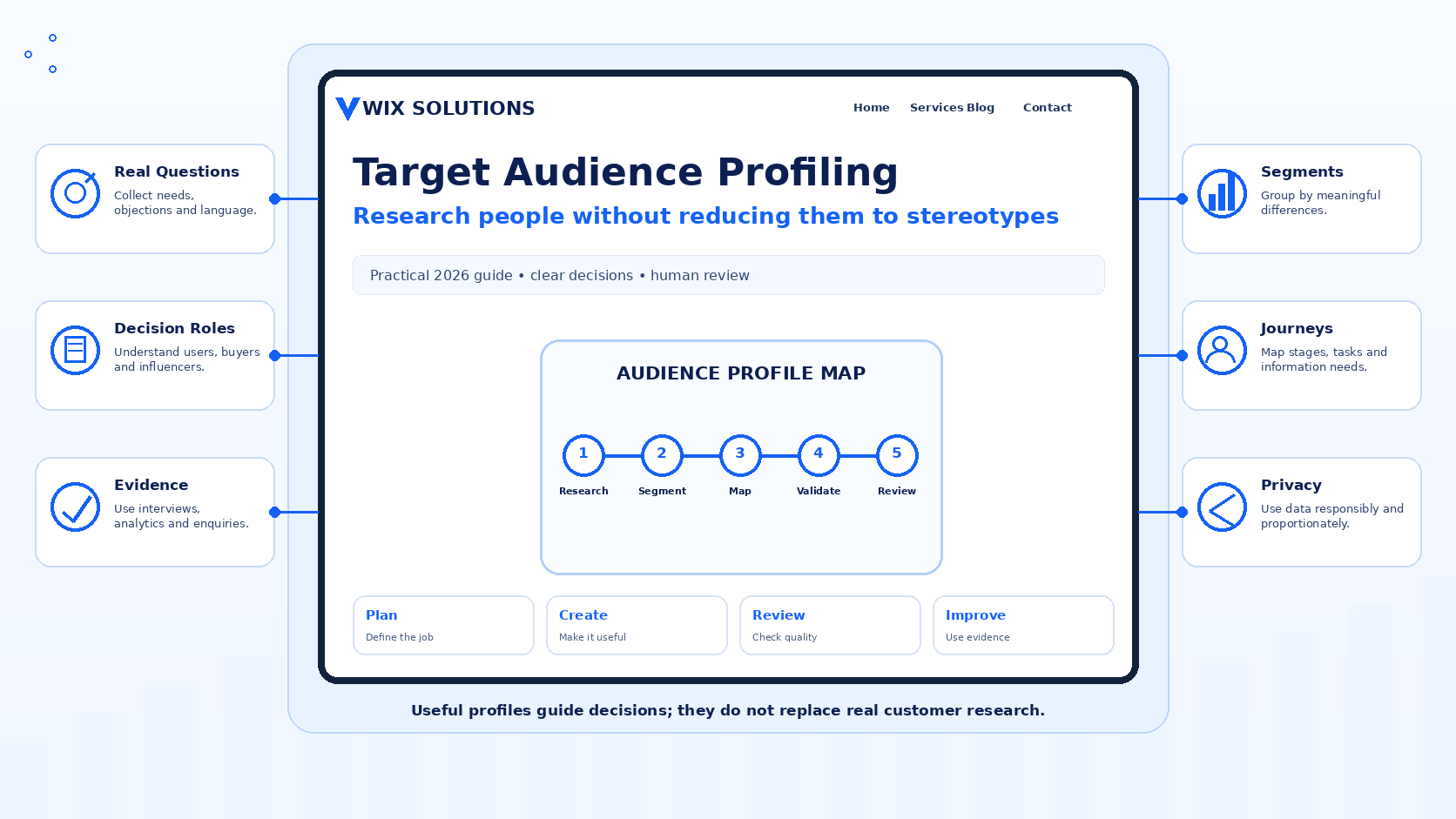
A target audience profile should help a business make better decisions, not reduce customers to a few demographic labels. Useful profiling combines evidence about needs, questions, behaviour, context and decision stages so teams can understand who a service or product is for, what information people require and where communication is currently unclear.
That distinction matters because modern marketing systems can collect large amounts of data and AI tools can identify patterns quickly. More data does not automatically produce better insight. Wix Solutions approaches target audience profiling as a practical research process: start with legitimate evidence, segment only where the difference changes a decision, validate assumptions and keep human judgement in control of how profiles are interpreted.

What a useful target audience profile should explain
A practical profile should explain what people are trying to achieve, which obstacles or concerns affect the decision, what information they need, how familiar they are with the subject, which channels they use in relevant contexts and what would make the next step easier. Demographics can matter when they genuinely affect the offer, but they are rarely enough on their own.
For content planning, the profile should connect directly with a content strategy. If the audience research shows that prospective customers repeatedly misunderstand the implementation process, that insight can justify a process page, comparison guide, FAQ or explanatory video. Research becomes valuable when it changes what the business does.
Target audience research should begin with evidence
Useful evidence can come from customer interviews, enquiries, sales notes, support conversations, website analytics, on-site search, surveys, reviews, CRM patterns and search research. Each source has limitations. Analytics can show what happened but may not explain why; interviews provide depth but may involve a small sample; sales notes can reveal objections but may overrepresent people who already reached a late stage. Combining sources helps reduce the risk of treating one signal as universal.
Segment only when the distinction changes a useful decision
Segmentation is helpful when two groups genuinely need different information, offers, journeys or channels. A training provider may need separate communication for business owners and internal administrators because their responsibilities differ. An online retailer may distinguish first-time buyers from repeat customers because their questions are different. Segmenting people simply because data is available can create unnecessary complexity.
Avoid turning profiles into stereotypes. Characteristics such as age, gender, job title or location should not be used as shortcuts for unsupported assumptions about motivation, ability or behaviour. A better profile explains observed needs and relevant context. It should also acknowledge uncertainty: audiences change, and a profile is a working model rather than a permanent truth.
Map audience needs across the customer journey
The same person may need very different information at different stages. Early in a journey, they may be trying to understand the problem and learn the available options. Later, they may compare providers, look for proof, review pricing or evaluate implementation. After purchase, they may need onboarding, support or guidance. Profiling becomes more useful when it connects a person’s context to the stage of the decision.
This journey view can inform Creative Content Creation because the creative format should match the information need. An early-stage visual explainer and a late-stage implementation checklist can be aimed at the same broad audience but solve different problems.
Use profiles to improve website structure and messaging
Audience insight should be visible in the website. Navigation labels should reflect how visitors understand services. Page introductions should address real questions rather than internal terminology. Calls to action should match readiness: someone researching may need a detailed guide, while someone comparing providers may be ready to book a consultation. Good profiling can also reveal when one page is trying to serve too many different intentions.
For more personalised journeys, the article on Content Personalization Strategies is a useful companion. Personalisation should be based on relevant, permissioned signals and a genuine customer benefit rather than using data simply because it is technically available.
Four practical target audience profiling examples
Example 1: a consultant serving owners and operations teams
A consultant may sell the same core service to business owners and operations managers. Owners may focus on risk, cost and strategic outcome, while operations teams may need practical detail about implementation, access and responsibility. The business can keep one service offer while creating different supporting information for each decision context. The profile distinction is useful because it changes the information architecture.
Example 2: an e-commerce store with first-time and repeat buyers
First-time shoppers may need detailed sizing, delivery, returns and trust information. Repeat buyers may already understand those policies and want faster access to new products, replenishment or loyalty information. The store can use analytics and customer questions to confirm whether these needs are real before changing navigation or email journeys.
Example 3: a local appointment business with different readiness levels
A clinic, salon or specialist local service may attract visitors who know exactly what they want and others who are unsure which service is suitable. Profiling those intentions can justify both direct booking paths and educational service-comparison content. The business does not need to guess personality types; it needs to support two observable information needs.
Example 4: a B2B software company with users and buyers
A software company may have day-to-day users, technical reviewers and budget holders involved in the same purchase. Their concerns overlap but are not identical. The content system can provide workflow examples for users, security and integration detail for technical reviewers, and implementation or commercial information for decision-makers. A shared account may involve several audiences rather than one fictional persona.
How AI tools can support target audience profiling
AI can accelerate analysis when a business has a large volume of legitimate research material. It can group recurring questions, summarise interview notes, classify support messages by topic, identify repeated objections, compare themes across surveys and help teams explore possible journey stages. This can make qualitative material easier to review, particularly when the source data is clearly defined.
Where AI can help audience research teams
A team could use AI to create a first-pass coding system for interview transcripts, surface frequently mentioned questions or compare wording used by customers with wording used on the website. It can also help draft research questions, provided a human checks that they are neutral and appropriate. These are analytical support tasks; they do not prove that a pattern is representative.
Why human judgement, privacy and validation remain essential
AI can reproduce bias in source data, invent explanations for patterns and make small samples look more certain than they are. Audience data may also include personal or sensitive information that requires appropriate handling, consent and governance. Human reviewers must decide what data should be used, whether segmentation is fair and relevant, and whether the profile describes evidence rather than a stereotype.
Validate profiles through real behaviour and ongoing feedback
A profile is useful only if it improves decisions. After changing content, navigation or campaigns, review whether the intended audience can find information more easily and whether the new structure reduces confusion. Speak to customers again. Compare assumptions with observed behaviour. Retire distinctions that do not affect anything useful.
The measurement principles in Content Performance Analysis can help teams separate observation from assumption. Profiling should remain connected to evidence and be updated when new information contradicts the original model.
Build audience profiles that improve real decisions
Target audience profiling is most valuable when it makes communication more useful. Research should clarify needs, segmentation should change a meaningful decision, journey mapping should explain context and validation should keep assumptions honest. The result is not a fictional biography of the “perfect customer”; it is a practical model that helps teams design clearer content, website journeys and marketing activity.
Wix Solutions can support audience research as part of broader website, content and digital strategy work. The purpose is to make evidence easier to act on while keeping customer dignity, privacy and human judgement at the centre of the process.


