Content Performance Analysis: How to Measure What Matters

Updated: Nov 22, 2024
Content performance analysis is useful when it helps a team decide what to do next. A page view, click or ranking is only a signal. The important question is whether the content is fulfilling the role it was designed for: attracting the right search intent, explaining a service, helping a visitor compare options, supporting a purchase, reducing repeated questions or moving someone towards a relevant next step.
Wix Solutions approaches content performance as an evidence-led editorial process rather than a monthly reporting exercise. Define the job first, collect signals that relate to it, interpret those signals in context and choose an action. In 2026, AI can make analysis faster, but it still cannot explain business context or causation on its own.

Start content performance analysis with the content objective
Different assets require different measures. A top-of-funnel search guide may be successful if it attracts relevant discovery and sends readers to a deeper resource. A service comparison page may be judged by progression to service detail, consultation or pricing information. A support article may be valuable because it answers a common question without any conversion at all. Measurement only makes sense when the original purpose is clear.
The Content Strategy Development guide explains how to connect publishing decisions to business objectives before production begins. That connection makes later analysis far more useful because the team knows which outcome each important asset should support.
Content performance metrics should match the job
Useful signals may include search impressions, query relevance, organic landing traffic, internal-link clicks, scroll depth, form starts, assisted conversions, repeat visits, product-page progression, support deflection, email sign-ups or engagement with an interactive tool. Avoid treating every available metric as equally important. A small number of job-specific measures are usually easier to interpret than a dashboard full of unrelated numbers.
Combine analytics with search intent and customer-journey evidence
Analytics describe behaviour, but behaviour needs context. A page with a short visit may be failing to answer a question, or it may answer the question quickly. A high-traffic article may appear successful while attracting people who are unlikely to need the business. A lower-volume page may contribute to high-quality enquiries. Interpretation improves when analytics are compared with the search intent, customer journey and actual purpose of the asset.
Audience context from Target Audience Profiling can help explain whether a content journey reflects the questions and decision stages that matter to the intended customer.
Use search data to diagnose relevance, not just visibility
Search performance should be reviewed at query level where possible. Impressions for unrelated searches can make visibility look stronger than it is. Check whether the page is appearing for the topic and intent it was written to satisfy, whether important sections answer the questions suggested by those queries and whether internal links connect the page to the next logical resource. Ranking movement without intent alignment is not a meaningful improvement.
Look for content friction in the customer journey
A performance review can reveal where readers lose context or reach a dead end. If many visitors read an educational article but rarely progress to relevant service information, the problem may be the internal-link structure, an unclear call to action or a mismatch between the article and commercial offer. If users repeatedly return to the same section of a help guide, the page may need clearer steps or a visual example.
Four practical content performance examples
Example 1: a search article with traffic but little relevant progression
Suppose an article attracts steady organic visits but very few readers explore related pages. Before calling it unsuccessful, review the queries, the article promise and its role. If the page attracts genuinely relevant research-stage visitors, add clearer internal links to the next useful topic rather than forcing an enquiry call to action. If the queries are unrelated, the better action may be to refocus the content.
Example 2: a service page that receives visits but creates repeated questions
A service page may have acceptable traffic while the sales team still receives the same basic questions about process, suitability or timescales. That is a performance signal. Review the page against those questions, not only analytics. Adding a clear process section or comparison block may improve the customer journey even if total traffic does not change.
Example 3: several articles competing for the same search intent
A content library may contain three older posts covering nearly the same question. Search impressions and internal links are divided across them, while none provides a complete answer. A performance review can identify the overlap and support consolidation into one stronger resource with appropriate redirects. More URLs are not automatically better.
Example 4: a product guide that assists purchases without being the final page
A buying guide may rarely be the final page before checkout, but customers who read it may be more likely to continue to relevant products or compare options efficiently. Review internal progression and assisted outcomes rather than attributing value only to last-click conversion. The guide’s job is decision support, so analysis should reflect that role.
How AI tools can support content performance analysis
AI can help teams work through large exports and qualitative evidence more efficiently. It can group search queries by theme, summarise recurring customer questions, flag unusual changes in performance, compare headings across overlapping pages and produce a first-pass list of assets that may need review. It can also help translate a large analytics export into hypotheses for a human analyst to investigate.
Where AI can accelerate content performance analysis
A useful application is classification. AI can group hundreds of search terms or support messages into themes, identify pages with similar topic coverage or summarise changes between two reporting periods. These tasks reduce manual sorting. The result should still link back to source data so the team can verify what changed and whether the pattern is meaningful.
Why AI cannot prove causation or business value
AI can describe correlation but may confidently invent a reason for it. A traffic decline could relate to seasonality, search changes, technical issues, a competing page, changing demand or several factors at once. Attribution also becomes complicated across long customer journeys. Human analysts must check the data, understand commercial context and avoid turning a plausible explanation into a false conclusion.
Turn findings into four editorial actions
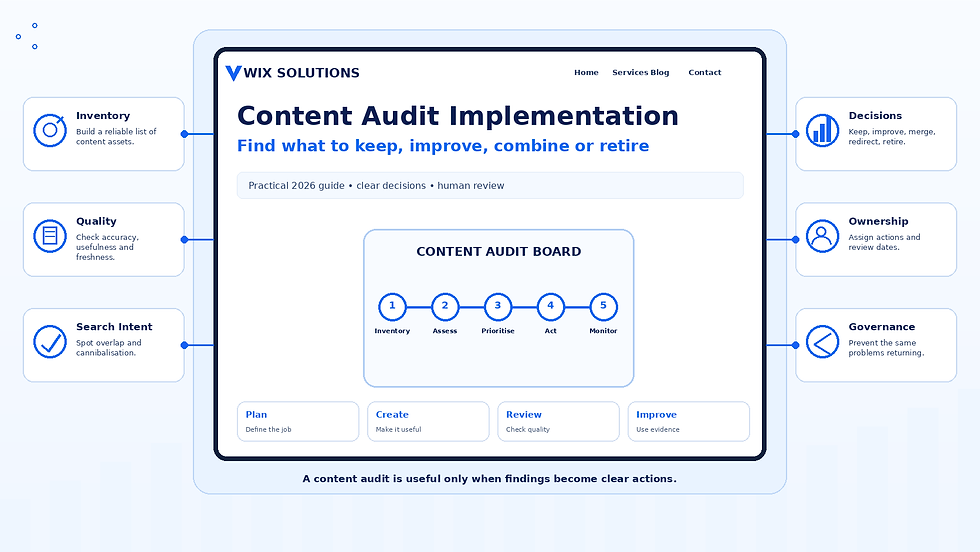
A useful review should end with an action. Keep content that still solves its job and remains accurate. Improve content that has useful intent but weak structure, evidence or journey support. Consolidate overlapping material when one stronger destination would be clearer. Retire content that is obsolete, misleading, redundant or no longer relevant, using redirects where needed to protect useful paths.
A structured Content Audit Implementation can turn these actions into a manageable worklist across a larger website.
Review performance over the content lifecycle
Performance changes as information ages, services evolve and search behaviour shifts. Important assets should be reviewed at sensible intervals rather than judged once after publication. Recent campaign content may need close monitoring, while evergreen guidance can be reviewed less frequently. The purpose of the review schedule is to catch meaningful change without creating unnecessary reporting work.
The Content Lifecycle Management guide explains how maintenance, repurposing and retirement fit into the wider publishing process.
Use evidence to improve content, not simply to report on it
Content performance analysis should make the next editorial decision clearer. Define the asset’s job, choose signals that match that job, interpret analytics with search and customer context, investigate rather than assume causation and finish with a practical action. That creates a measurement system that supports better content rather than a dashboard that merely describes activity.
Wix Solutions can support performance review as part of broader website, SEO and content strategy work. The goal is to connect data with useful human judgement so content remains accurate, discoverable and relevant to the people it was designed to help.