Content Strategy Development: A Practical Framework for Business Growth

Updated: Feb 18
A strong content strategy gives a business a reason for every article, page, email, video or social post it creates. Instead of publishing because a calendar says something is due, the organisation decides which audience problem it is solving, what business objective the content supports, how the material will be distributed and how its usefulness will be reviewed.
That discipline matters in 2026 because businesses have more ways to create content than ever, including AI-assisted research and drafting. Greater production capacity is not the same as a better strategy. Wix Solutions approaches content strategy development as an editorial and business-planning process: understand demand, choose priorities, create useful material, connect it to the wider website and improve it using evidence rather than assumptions.

How content strategy development connects business goals to useful publishing
A content strategy sits between business priorities and day-to-day content production. It translates goals such as generating qualified enquiries, supporting customer onboarding, improving product understanding or strengthening organic visibility into specific editorial decisions. That means choosing topics, formats, destinations and calls to action because they serve a defined purpose, not because they happen to be fashionable.
The first input is audience understanding. A useful strategy looks beyond broad demographics and identifies the questions, doubts, information needs and decision stages that shape real behaviour. The related guide on Target Audience Profiling explains how a more structured audience view can improve the relevance of content decisions.
Content strategy development decisions before production
Before commissioning a new asset, define its audience, intent, job and next step. A content strategy brief should answer who the material is for, which question it needs to resolve, why the topic matters now, what evidence is required, what action should follow and how the team will judge whether the content is still useful later. This prevents a common problem: attractive content that receives attention but has no clear relationship to a commercial or customer objective.
Start with a content audit, not a blank calendar
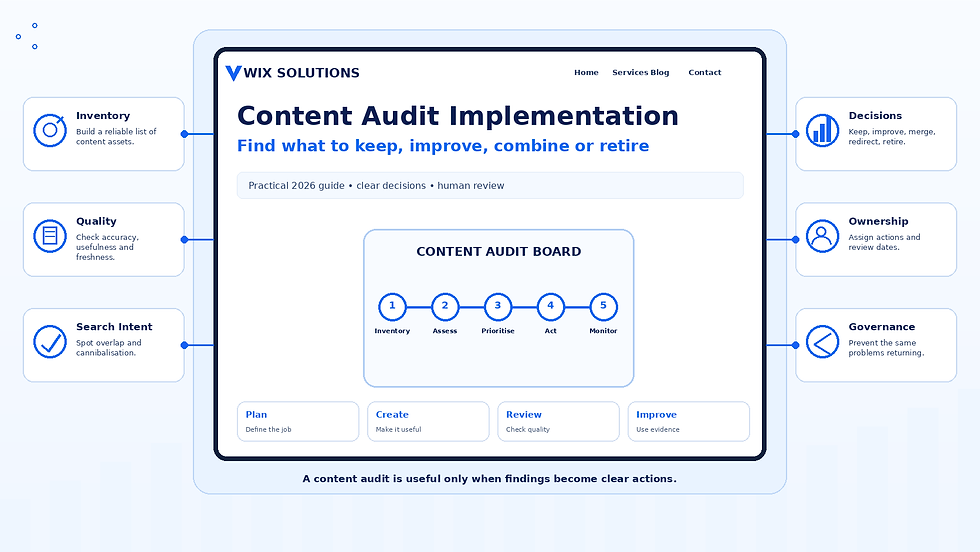
Many businesses already have more content than they realise: service pages, old blog posts, campaign landing pages, FAQs, downloadable documents, case studies, product descriptions, videos and social material. A sensible strategy begins by reviewing what exists. The objective is not to score every asset for the sake of a spreadsheet. It is to identify what should be kept, updated, combined, redirected, repurposed or retired.
The existing article on Content Audit Implementation is a useful next step when you need a practical framework for assessing a content library. An audit can also reveal keyword overlap and duplicated intent. If three articles answer essentially the same question, publishing a fourth usually creates more maintenance rather than more value.
Define goals that change editorial decisions
Goals are only useful when they influence what the team does. “Increase engagement” is too vague on its own. A stronger objective might be to help prospective clients understand a complex service before a consultation, reduce repeated pre-sales questions, support an important category in organic search or provide existing customers with clearer self-service guidance. Each of those objectives leads to different content formats and measurements.
Our guide to Goal-Driven Content Creation develops this principle further. The important point is to connect the goal to an observable behaviour or outcome, then choose measures that reflect that outcome rather than relying on a single vanity metric.
Build themes, formats and channels around intent
A content plan becomes easier to manage when related topics are organised into clear themes. A professional services business might group content around service education, decision support, implementation guidance, industry-specific questions and ongoing client support. An e-commerce business may organise around product discovery, comparison, use cases, care guidance and post-purchase help. Themes create coherence without forcing every asset into the same format.
Channel choice should follow audience behaviour and the job of the content. A detailed comparison may belong on the website; a concise reminder may suit email; a visual explanation may work on social media; a technical answer may deserve a searchable help article. The article on Channel Optimisation Planning provides more detail on matching distribution choices to purpose.
Four practical content strategy examples
Example 1: a consultancy with an unclear service journey
Imagine a consultancy receiving enquiries from people who do not understand the difference between an initial assessment and a full implementation project. A useful strategy would prioritise a clear service page, an explainer comparing the two stages, an FAQ covering common objections and a short follow-up resource for people who have booked a consultation. The goal is not maximum content volume; it is reducing uncertainty at specific decision points.
Example 2: an online shop with strong products but weak guidance
An online shop may have excellent product pages but still lose shoppers because comparison information is difficult to find. The strategy could prioritise buying guides, category introductions, product-use articles and post-purchase care instructions. Each piece would link naturally back to relevant products or categories. Performance would be reviewed through useful behaviours such as navigation to product pages, assisted conversions and reduced repeated support questions, not simply page views.
Example 3: a local service business competing on trust
A local service business may need to demonstrate expertise without making every article sound promotional. A balanced plan could include location-relevant service pages, practical preparation guides, process explanations, genuine customer questions and evidence-led case studies. The content should answer what prospective customers actually want to know: availability, suitability, process, standards, expected next steps and how to choose between options.
Example 4: a B2B team with too many disconnected campaigns
A B2B marketing team may publish webinars, reports, landing pages and social posts without a shared structure. A content strategy can organise these assets around a small number of buyer problems, define which core resource anchors each campaign and specify how supporting formats are repurposed. Instead of repeatedly starting from zero, the team creates a connected information system in which each asset has a clear role and maintenance owner.
How AI tools can support content strategy development
AI tools can accelerate parts of strategic content work, particularly when a team needs to organise a large amount of information. They can help cluster customer questions, summarise research notes, compare themes across existing pages, suggest alternative structures for a brief, identify repeated wording and turn an approved long-form asset into draft ideas for other formats. Used carefully, this can reduce administrative effort and give strategists more time to evaluate priorities.
Where AI can accelerate research and planning
A practical workflow might combine verified search data, customer-service notes, sales questions and analytics exports, then use AI to group patterns for human review. AI can also produce first-pass content inventories, draft metadata options or highlight sections that appear inconsistent across related pages. These are useful productivity tasks because the source material can be checked. The output should be treated as analysis to review, not as an authority.
Where human judgement remains essential
AI cannot decide which commercial objective deserves priority, whether a customer insight is representative, whether a claim is sufficiently evidenced or whether a draft genuinely reflects the brand. It can also produce confident but inaccurate summaries, flatten important nuance and reproduce weak assumptions in the prompt. Human review is therefore essential for source verification, originality, tone, legal or regulatory sensitivity, accessibility and final editorial decisions.
For teams using AI as part of production, the related article on Creative Content Creation is a useful companion because strategy and creative execution need different types of judgement.
Measure content by the job it was created to do
Measurement should be selected before publication whenever possible. A service explainer might be judged by progression to a relevant service page or consultation step. A support article may be more valuable if it reduces repeated questions. A search-led guide may be reviewed through impressions, qualified organic visits, engagement with internal links and whether it contributes to the wider topic cluster. No single metric proves content quality.
The guide to Content Performance Analysis explains how to connect data with interpretation. The purpose of measurement is to make a better decision: keep, improve, consolidate, redistribute or stop.
Manage the content lifecycle after publication
Content strategy does not end at publish. Information becomes outdated, offers change, internal links break, screenshots age and search intent shifts. High-value assets should have owners and sensible review intervals. Some material deserves frequent maintenance; some can remain stable for longer. The key is to make review deliberate rather than waiting for a page to become obviously obsolete.
Our article on Content Lifecycle Management covers this maintenance stage in greater depth. A good lifecycle process protects the investment already made in research, design and writing while keeping the website useful for current visitors.
A practical content strategy checklist
Before approving the next content cycle, check that the team can explain the audience need, business objective, search or customer intent, evidence requirements, format, distribution plan, internal links, owner, success measures and review date for each important asset. Not every small post needs a complex document, but important content should never exist without a reason and a responsible owner.
Build a strategy that makes publishing easier to justify
Content strategy development is valuable because it introduces deliberate choices. It helps a business decide what not to publish as confidently as what to create. By connecting audience research, clear goals, useful themes, appropriate channels, responsible AI assistance, measurement and ongoing maintenance, the content library becomes easier to manage and more useful to the people it is meant to serve.
Wix Solutions can support this work as part of wider website, content and digital strategy projects. The objective is not to create more pages for the sake of activity. It is to build a connected content system in which each important asset has a purpose, supports the wider customer journey and can be reviewed against evidence over time.