The Role of Social Media in Digital Marketing

Social platforms have an important role in digital marketing, but they are not the whole system. They help businesses earn attention, participate in conversations, distribute useful content and learn how audiences respond. The website, search presence, email list, customer records and service experience then provide the depth and continuity needed to turn that attention into a relationship.
A strong strategy therefore avoids treating social activity as a separate publishing department. Content themes should come from customer questions and commercial priorities. Campaign links should lead to relevant pages. Enquiries need a reliable follow-up process. Insights from comments and behaviour should influence future content, products and service design.
Wix Solutions connects social strategy with the wider customer journey so that creative work has a purpose, the business retains useful assets and measurement reflects meaningful progress rather than popularity alone.

The Role of Social Media Across Digital Marketing
The role of social media changes across the customer journey. At discovery, it can introduce an idea or business to people who were not actively searching. During evaluation, it can demonstrate expertise, show products in context and provide social proof. At action, it can guide interested people to a website, booking, event, shop or resource. After purchase, it can support community, education and return visits.
This influence is rarely linear. A customer may see a short video, search the business name days later, read a guide, join an email list and finally make an enquiry after a referral. Good digital marketing respects that complexity while still creating enough structure to learn what is helping.
Social media as a discovery channel
Search marketing responds to existing intent; social media can create or shape intent. A useful post may name a problem the audience has not yet defined, show a product in a new context or make a specialist topic understandable. Distribution depends on the platform and audience response, so businesses should not assume every follower will see every post.
Discovery content needs a recognisable point of view and a clear audience. Broad motivational statements may receive casual reactions without attracting suitable customers. Specific, credible content is more likely to earn the attention of people who can benefit from the offer.
Social media as a listening and research channel
Comments, direct messages, saves, repeated questions and customer-created content provide qualitative evidence. They can reveal objections, misunderstood language, unmet information needs and emerging demand. This evidence should be recorded and compared with website search, sales conversations and customer support.
Listening is not the same as allowing a few loud comments to dictate strategy. Review patterns, context and commercial relevance. A business may discover a valuable topic even when the post itself has modest reach.
Social media as a content-distribution layer
A digital marketing programme often contains deeper assets: guides, case studies, product collections, webinars, tools, event pages and email sequences. Social content can introduce those assets in formats suited to each platform. One article can generate a concise explanation, visual example, question, short demonstration and follow-up discussion without being copied identically everywhere.
The owned version should remain on the website where the business controls presentation, updates, search visibility and conversion paths. Social posts act as entry points rather than the only home of valuable knowledge.
Social media as a trust-building environment
Trust develops through consistency, relevance and behaviour. Showing how work is done, explaining limitations, responding responsibly and presenting credible evidence can reduce uncertainty. Over-polished claims, invented urgency and automated replies can have the opposite effect.
Customer reviews and user-generated content can be valuable, but permission, context and moderation matter. Regulated or high-stakes industries also need clear approval processes so that useful communication does not become misleading advice.
Social media as a paid-media channel
Paid social can extend suitable content beyond an existing audience and support retargeting or lead generation where consent and platform rules allow. It works best when the offer, creative, audience, landing page and follow-up are designed together.
Testing should change one meaningful variable at a time: audience, proposition, creative angle, format or landing-page message. A low click cost is not sufficient if the resulting traffic is unsuitable. Review qualified actions and downstream value.
Social media as a customer-retention channel
After purchase, social media can provide education, inspiration, service updates and community. A publisher can support readers between launches; a venue can keep audiences connected between events; a fashion marketplace can explain care and maker stories after the sale. Retention content should add value rather than repeat acquisition messages.
Email and customer accounts provide more dependable direct relationships, so invite people to join them when appropriate. Platform audiences are valuable, but they remain subject to changing algorithms, policies and account access.
Connect social media with the owned customer journey
Define the audience and the question each content theme addresses.
Create relevant landing pages rather than sending every click to the homepage.
Use campaign parameters and form-source fields consistently.
Connect sign-ups, bookings, purchases and enquiries with appropriate follow-up.
Retain useful guides, case studies and product information on the website.
Record recurring audience questions for future content and service improvement.
Build an email or membership relationship with clear consent where it adds value.
Review both platform signals and commercial outcomes.
For a practical guide to building the platform presence itself, read How to Build a Strong Social Media Presence for Your Brand.
Choose metrics by marketing role
Different content has different jobs. Discovery may be assessed through suitable reach, profile visits and new website users. Evaluation content may be judged by completion, saves, guide downloads or relevant page visits. Conversion activity needs booking, enquiry or purchase measures. Retention requires repeat behaviour, community participation and customer feedback.
Distribution: reach among the intended audience, impressions and frequency.
Attention quality: video completion, saves, meaningful comments and profile actions.
Owned-media progression: website sessions, landing-page behaviour and email sign-ups.
Commercial action: qualified enquiries, bookings, orders, event registrations and assisted conversions.
Relationship: repeat purchase, return visits, community participation and response quality.
Efficiency: production time, response time, cost per qualified action and content reuse.
Attribution is an informed model, not perfect truth. Direct traffic, referrals and delayed decisions can hide part of social media’s contribution. Use tracking, customer-source questions and journey analysis together, and avoid assigning all value to the final click.
Risk, governance and resilience
Social media moves quickly and is publicly visible. Define who can publish, who approves sensitive topics, how messages are handled and what happens during an incident. Maintain access controls, multi-factor authentication, asset ownership and an escalation path for complaints, misinformation or account compromise.
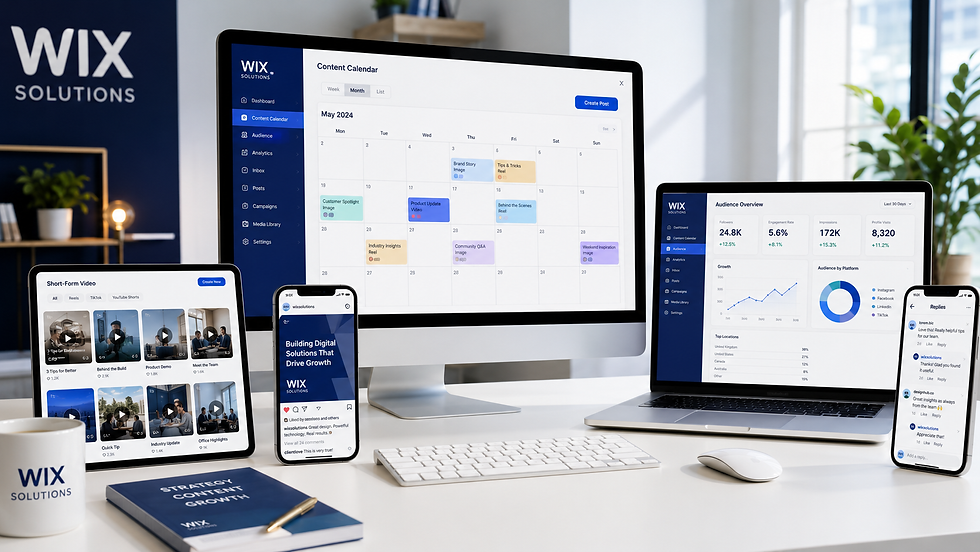
A content calendar should include review dates and responsibilities, not only publication times. Regulated statements, prices, event details and product availability need particular care. The business should also keep important source files and content records outside a single platform.
Illustrative case studies across five industries
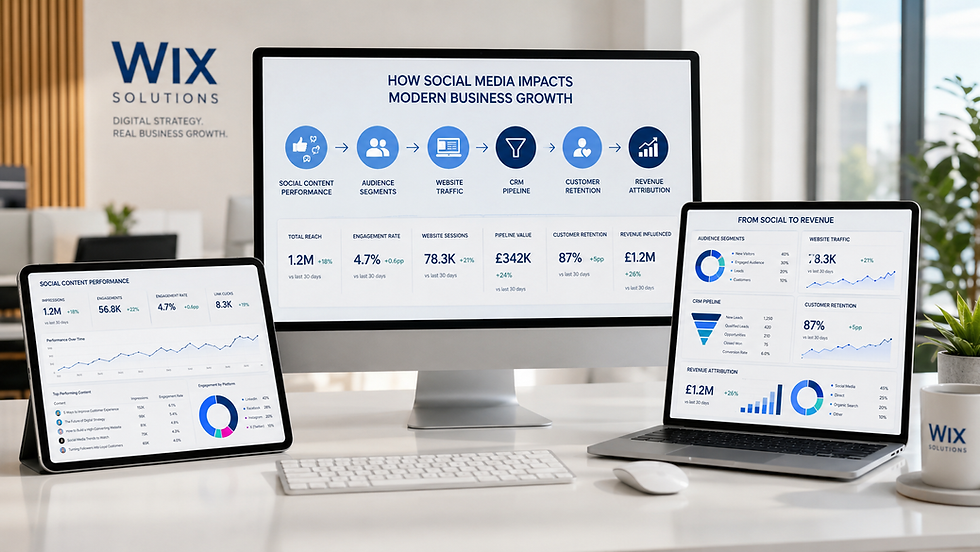
The following case studies are fictional composites. All names, people, products, testimonials, charts, dashboards and performance figures shown in the graphics are illustrative. They are not Wix Solutions client results or guaranteed outcomes.
Case study 1: Independent book publisher
Situation: A small publisher relied on isolated launch announcements. Author stories, reader communities, pre-orders, event information and email sign-ups were not connected.
Integrated approach: The campaign began with reader interests and the author’s themes. Behind-the-scenes content and excerpts introduced the book, while a focused landing page held accurate information, pre-order links and email consent. Reader Q&As and launch events created conversation beyond promotional posts.
What to assess: Suitable audience growth, landing-page visits, email sign-ups, pre-orders, event participation, content-source patterns and reader engagement after launch.

Case study 2: Independent optician
Situation: An optician had loyal local customers but little connection between educational content, frame styling, reviews, local discovery and online appointment booking.
Integrated approach: Helpful eye-care information remained general and avoided individual medical claims. Frame demonstrations and team content made the practice tangible. Local posts linked to relevant service and booking pages, while a documented review-response process protected tone and privacy.
What to assess: Local website visits, appointment completion, suitable enquiries, content questions, review response, source attribution and repeat appointment behaviour.

Case study 3: Cybersecurity consultancy
Situation: A specialist consultancy had strong expertise but described services in language that non-specialist decision-makers found difficult to apply. Social posting was irregular and disconnected from lead qualification.
Integrated approach: Threat-education posts explained practical decisions without publishing unsafe detail or creating fear. Webinars and downloadable guides linked to focused landing pages. Enquiry forms captured organisation type and need, while incident-communication content followed an approval checklist.
What to assess: Guide and webinar registration, qualified enquiries, topic relevance, landing-page progression, sales feedback and adherence to content review controls.

Case study 4: Live events venue
Situation: A venue announced events across several channels, but ticket information, accessibility, artist assets, waitlists and post-event retention were inconsistent.
Integrated approach: Each event used one accurate website page as the source of truth. Social content introduced artists and community stories, then directed people to ticketing or a waitlist. Accessibility information appeared with the event detail. Post-event emails and content encouraged suitable return visits.
What to assess: Event-page visits, ticket and waitlist progression, source mix, accessibility-page use, newsletter sign-ups, repeat booking and customer-service questions.

Case study 5: Sustainable fashion marketplace
Situation: A multi-maker marketplace needed to explain materials and provenance while promoting product drops. Broad sustainability language risked becoming vague or overstated.
Integrated approach: Maker stories linked to detailed website information and evidence available for each product. Social formats introduced garments and care guidance; collections and email capture supported shopping and future releases. Claims were specific, reviewable and limited to information the marketplace could substantiate.
What to assess: Maker-story engagement, collection visits, email sign-ups, product-page progression, repeat purchase, claim-review compliance and enquiries about materials or care.

A practical integrated planning cycle
Set one business objective and define the audience affected.
Map the customer questions and existing evidence.
Choose the role of each channel: discovery, depth, action or retention.
Create source content and adapt it for relevant platform formats.
Build the website destination, tracking and follow-up before promotion.
Publish, respond and record useful qualitative signals.
Review platform, website and commercial evidence together.
Improve the next cycle and document what should stop as well as continue.
For a wider view of commercial impact and customer journeys, see How Social Media Impacts Modern Business Growth.
Frequently asked questions
Is social media necessary for every business?
No. It should be used when the intended audience is present, the channel supports a relevant behaviour and the business can maintain the required standard. Some organisations may gain more from search, partnerships, email or direct sales. The strategy should follow evidence, not pressure to appear everywhere.
How many social media platforms should a business use?
Use the number the business can serve well. One or two well-chosen channels connected to a strong website and follow-up process can be more useful than several neglected profiles. Review audience behaviour, content fit, risk and available resources.
What is the difference between social media marketing and digital marketing?
Social media marketing covers activity on social platforms, including organic content, community and paid campaigns. Digital marketing is broader and can include websites, search, email, content, advertising, customer data and digital experiences. Social media should connect with these other parts.
How should a business measure social media ROI?
Define the investment and intended outcome first. Combine platform costs, production time and management with qualified actions, revenue where appropriate, assisted conversions, retention and operational value. Use attribution carefully and document assumptions rather than presenting one figure as complete truth.
How Wix Solutions connects the system
Wix Solutions brings together social strategy, content, visual design, websites, landing pages, email capture, analytics and conversion journeys. We help business owners decide what each channel should do and create a practical workflow for publishing, response and improvement.
The aim is a resilient digital presence in which social media earns attention and insight, while owned systems turn that attention into useful customer relationships.
Visual consistency helps those touchpoints feel connected. Read The Role of Visuals in Modern Digital Marketing for the design perspective.
Bibliography
Tuten, Tracy L. Social Media Marketing. 5th edition. SAGE Publications, 2023.
Chaffey, Dave and Ellis-Chadwick, Fiona. Digital Marketing: Strategy, Implementation and Practice. 8th edition. Pearson, 2022.
Kingsnorth, Simon. Digital Marketing Strategy: An Integrated Approach to Online Marketing. 3rd edition. Kogan Page, 2022.
Pulizzi, Joe. Epic Content Marketing. 2nd edition. McGraw Hill, 2023.
Berger, Jonah. Contagious: Why Things Catch On. Revised edition. Simon & Schuster, 2016.