Website Competitor Analysis: A Practical Planning Guide

Updated: Nov 12, 2024
Website competitor analysis is useful when it helps a team make better choices, not when it becomes a catalogue of features to copy. A disciplined review can reveal customer expectations, common journey patterns, content gaps and areas where the market feels indistinguishable. It cannot prove why a rival performs well, expose private commercial data or replace research with your own customers.
The strongest process begins with a decision. You may need to clarify a new website brief, improve an underperforming service journey, assess a content opportunity or identify a credible point of difference. That question determines which organisations to study, what evidence to capture and how the findings should influence the roadmap.

This guide covers research scope, journey review, search and content signals, technical observations, copyright, data protection and responsible AI. It is practical planning guidance rather than legal advice. Where ownership, licensing or personal-data use is uncertain, obtain advice for the specific circumstances.
What Website Competitor Analysis Can Tell You
Competitor research can show what customers repeatedly encounter when comparing options. Common terminology, proof formats, delivery explanations and action patterns may indicate an established expectation. Differences can reveal a positioning choice or an unserved question. A dated review can also provide a useful baseline for later planning.
Public pages do not reveal conversion rates, profitability, customer satisfaction, internal capability or the reasons a design was chosen. Search positions and visible activity can change. Treat observations as evidence for a hypothesis, not proof of success. A polished feature may be expensive to maintain or irrelevant to the customers you most need to serve.
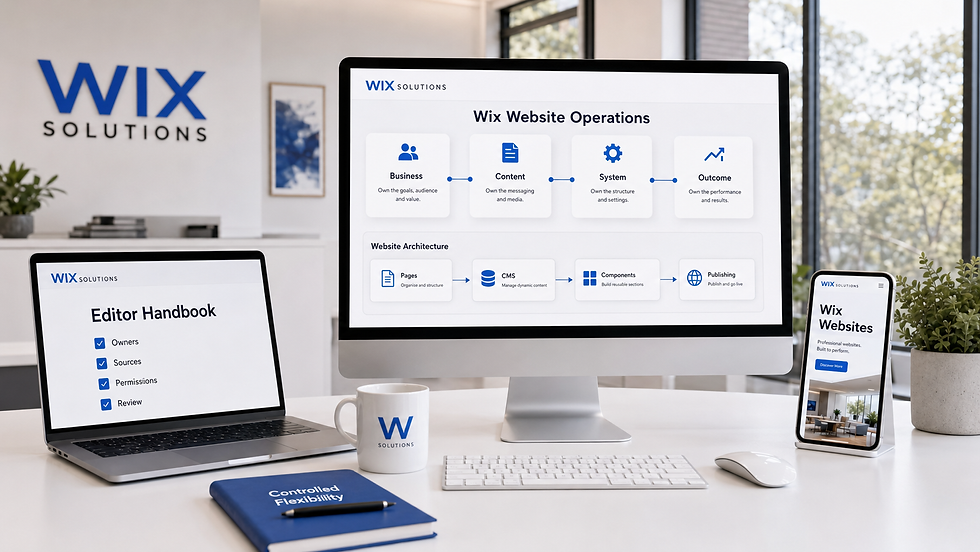
The guide to Wix websites that teams can operate provides a useful counterweight: every idea should be tested against ownership, maintainability and a real customer action. The visible interface is only one part of a working website system.
Frame the Research Before Opening Tabs
Website Competitor Analysis: Define the Customer and Decision
Write a short research question that names the audience, journey and intended decision. Instead of asking which site is best, ask how comparable providers explain a complex service before an enquiry, or which information retailers give before collection. Add the constraints that matter to your organisation, including evidence, budget, accessibility, capacity and compliance.
Record what your own customers already say. Interview notes, sales objections, internal search terms, support questions and form submissions can establish the needs against which other websites are reviewed. Use anonymised or appropriately controlled information. A rival should not become the default source of truth about your audience.
Choose a balanced comparison set
Include direct competitors serving a similar audience, alternative ways customers solve the same problem and one or two organisations known for a relevant journey outside the immediate category. Note why each was included. A small, well-chosen set is usually more useful than an automated list of hundreds of domains.
Keep geography, business model, scale and customer type visible. A national marketplace and a local specialist may be compared for a single interaction, but their content operations and budgets are not equivalent. Avoid treating the loudest search advertiser as the market leader without supporting evidence.
Create an evidence record
Capture the page URL, review date, device or viewport, observation and customer implication. Separate what you saw from what you inferred. Screenshots can support internal discussion, but access and retention should be controlled and the source recorded. Recheck important findings before a decision because websites change.
Use a consistent rating scale only when the criteria are defined. A label such as strong is too vague. A more useful assessment might record whether the service boundary is stated, evidence is connected to the claim, keyboard focus is visible or a form confirms the response process. This makes the review repeatable.
Review the Offer, Evidence and Brand Position
Begin with the promise. Identify the audience named, problem described, result proposed and limits stated. Note whether the site relies on broad superlatives or provides specific process detail. Compare how pricing, timescale, eligibility, delivery and risk are explained. Missing information may represent an opportunity, but it may also reflect a deliberate sales process.
Review the evidence attached to important claims. Look for named credentials, transparent methodology, permissioned case work, original research and clear policies. Count neither testimonials nor badges as proof without checking their context. Your own response should be grounded in evidence you can maintain rather than an attempt to outclaim a rival.
A practical start-up branding guide can help turn the findings into an original position, voice and visual system. Differentiation should come from real strengths, audience fit and delivery choices, not from changing another organisation's colours or slogans.
Walk the Customer Journey on Mobile and Desktop
Test discovery and orientation
Begin on a relevant landing page rather than always using the homepage. Check whether a new visitor can identify the offer, intended audience, location or delivery model and next step. Review navigation labels, heading order, internal links and the path to essential support information. Note where the journey assumes knowledge the customer may not have.
Test action and confirmation
Follow the journey towards a form, booking or checkout without submitting false data. Review field requirements, instructions, validation and privacy information. Note whether the confirmation explains what happens next and whether urgent or unsuitable enquiries have an alternative route. Compare the mobile journey with desktop rather than assuming responsive layout preserves clarity.
Assess accessibility as a human experience
Check keyboard navigation, visible focus, contrast, zoom, meaningful links, form labels and text alternatives. Automated tools can identify some issues, but they do not prove a journey is accessible. The purpose is not to grade competitors publicly. It is to identify customer needs and controls your own website should meet.
Compare Content and Search Signals Carefully
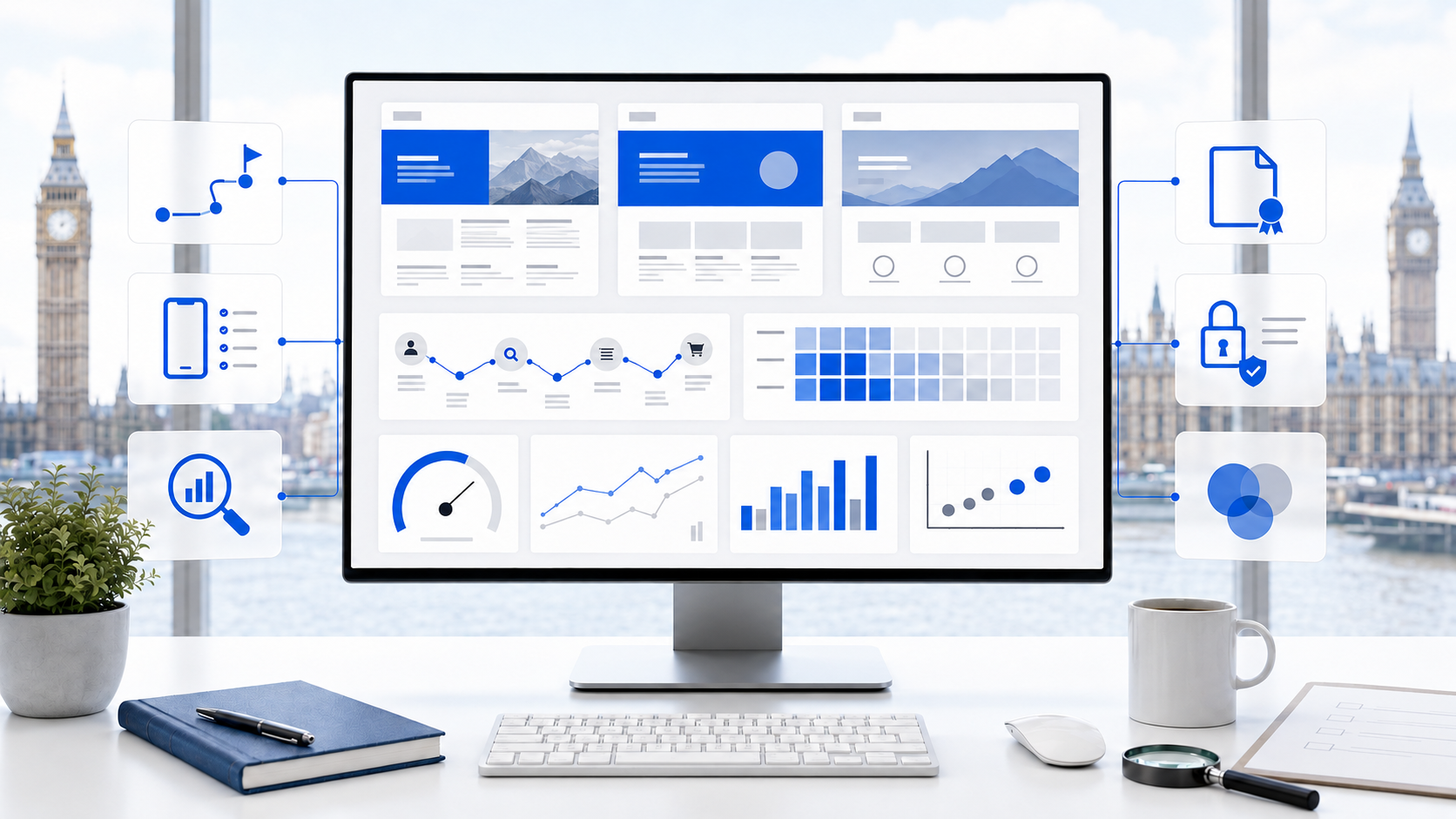
Map the subjects, formats and customer stages represented. Look for central guides, service pages, case evidence, questions, tools and updates. Record whether several pages overlap or form a clear topic structure. A large publishing volume is not automatically an advantage; much of it may be outdated, duplicated or disconnected from commercial journeys.
Use the SEO content strategy framework to translate observations into audience questions, topic architecture, original value and review ownership. The SEO fundamentals guide can support checks for crawlability, titles, headings, descriptive links and useful page structure.
Treat keyword and backlink tools as estimates with their own data sets and limitations. Record the date, market and tool where a number affects a decision. Do not describe another organisation's traffic, conversion or authority as fact when you only have a third-party estimate. Validate priority topics against customer and search evidence available to your own organisation.
Observe Technical Experience Without Guessing
Review visible outcomes such as mobile layout, image behaviour, error messages, consent controls and apparent loading friction. Browser tools can expose public resources, but a short test does not establish the full platform, code quality or operational performance. Network conditions, geography, caching, personalisation and third-party services can all affect what you see.
Use competitor observations to define requirements for your own site: acceptable journey behaviour, media budgets, integration needs, browser coverage and release checks. Do not copy source code, scripts, design assets or configuration. Recreate only the business requirement through an original, licensed and tested implementation.
Respect Copyright, Licensing and Data Protection
In the UK, copyright protection generally arises automatically for qualifying original work. The fact that text, photography, illustration, video or code is visible online does not make it free to reuse. Record the source and licence for every asset placed on your site, including template elements, stock media, fonts, icons and contributed material.
The Intellectual Property Office provides official guidance on digital images and copyright. Check permission, licence scope, attribution, editing and onward-use terms rather than assuming a credit resolves every requirement. Keep evidence of purchase or permission with the asset record.
Public research can still involve personal information, especially when names, profiles, reviews or contact details are collected and combined. Define the purpose, minimise what is recorded, control access and retention, and identify an appropriate lawful basis before processing. Do not build personal dossiers when a page-level observation answers the business question.
The Information Commissioner's Office explains that organisations relying on legitimate interests need to consider purpose, necessity and the balance with people's rights and freedoms. Review the ICO guidance on legitimate interests and seek appropriate advice where the use is complex.
Four Practical Research Scenarios
Practical Example 1: A professional service redesign
A consultancy reviews five comparable enquiry journeys against questions from recent sales calls. It records how scope, evidence, pricing approach and response expectations are explained. The team discovers that its own pages hide the engagement process, so it adds an original process diagram and a clearer qualification form. It does not copy a rival's case wording or visual layout.
Practical Example 2: An independent retailer
A retailer compares product discovery, collection, delivery and returns journeys across direct and alternative sellers. Mobile checks reveal that customers need stock and fulfilment information earlier. The roadmap prioritises structured product details and clearer confirmation messages. Promotional style is deliberately excluded because it does not answer the research question.
Practical Example 3: A local trades business
A trades firm studies how genuine service areas, emergency boundaries, accreditations and quote inputs are communicated. It finds widespread town-page duplication and chooses a different approach: fewer local pages with real coverage details, project evidence and monitored forms. The measure is qualified work by service, not the number of location pages published.
Practical Example 4: A membership organisation
A membership body reviews joining, renewal and support journeys on mobile and with a keyboard. It compares information sequence, form burden and confirmation states without collecting member data from other sites. Findings become acceptance criteria for its own rebuild, including plain-language eligibility, accessible validation and a named owner for policy changes.
Responsible AI in Competitor Research
AI can help organise authorised notes, cluster public page themes, draft an observation template and suggest questions for human review. It can compare supplied text at a structural level or flag places where an inference lacks evidence. These uses can reduce administrative work, but they do not make an observation accurate or a use of content lawful.
Do not ask an AI system to imitate a competitor's distinctive copy, visual identity, images or code. Do not upload licensed reports, private analytics, customer records, credentials or confidential screenshots to an unapproved service. Automated scraping, profiling and large-scale copying raise technical, contractual, copyright and data-protection questions that require deliberate review.
Keep sources, dates and confidence visible. Require a human to verify every claim and decide whether an insight reflects the target audience and your organisation's capability. Generated recommendations should enter the same prioritisation, accessibility, privacy, security and testing process as any other proposal.
Turn Findings into a Prioritised Roadmap
Group findings by customer problem, not competitor. Identify the evidence, expected outcome, owner, effort, risk and dependency for each proposed change. Separate table stakes from differentiators and experiments. A familiar interaction may reduce customer effort; an original tool or service promise may create distinction. Both need a reason and a measure.
Prioritise fixes that remove serious journey barriers, inaccurate information, accessibility problems or operational failures. Then test the smallest change that can answer an uncertain question. Document what the research did not establish. Revisit the comparison only when a decision or market change justifies it, rather than monitoring rivals continuously.
Wix Solutions offers professional Wix website design and wider planning support that can turn research into an original, manageable brief. The engagement should leave your team with clear requirements, ownership and evidence rather than a feature-by-feature imitation.
Conclusion
Good website competitor analysis narrows uncertainty. It compares public customer experiences, separates observation from inference, protects copyright and personal information, and converts findings into original priorities. Use rivals as one source of market evidence, then design for your own audience, capabilities and promise.
If you want an independent review of your website brief, customer journeys or differentiation opportunities, contact Wix Solutions with the decision you need to make, the audience involved and any research already completed.