

Content Audit Implementation: A Practical Website Content Review

Updated: Nov 22, 2024
A content audit is the practical bridge between knowing a website needs attention and deciding exactly what should happen next. It gives a business a structured way to review pages, articles, resources and other published assets for accuracy, usefulness, search intent, brand consistency, internal linking and ongoing value. The outcome should not be a spreadsheet that nobody revisits; it should be a prioritised action plan with clear owners and sensible next steps.
For Wix Solutions, content audit implementation means examining the whole information system rather than judging each URL in isolation. A weak page may need rewriting, two reasonable pages may be competing for the same search intent, an old article may contain outdated branding, and a useful resource may simply need better internal links. In 2026, AI can accelerate inventory and classification work, but decisions about accuracy, relevance, redirects, risk and business priorities still require human judgement.
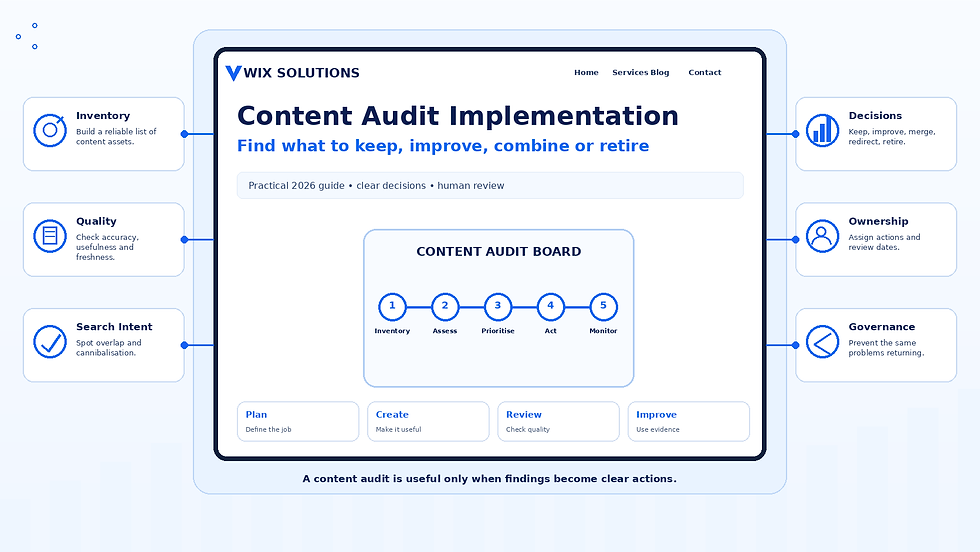
How to run a content audit without creating busywork
Start by defining the purpose and scope. A small service website may be reviewed in one complete inventory, while a large site may need to be divided by section, content type or commercial importance. Decide what information is needed before exporting anything. Typical fields include URL, title, content type, intended audience, purpose, current status, last meaningful update, search intent, internal links, conversion or journey role, owner and recommended action.
The wider Content Strategy Development process helps define what the content library is supposed to achieve. An audit becomes much easier to prioritise when the team knows which audiences, services and customer journeys matter most.
Content audit criteria for each page
For each important asset, ask a consistent set of questions. Is the information factually current? Does it still reflect the present brand and offer? Is the page aimed at a recognisable audience need? Does the search intent match the title and body? Is the content sufficiently distinct from other pages? Do internal links help a reader continue naturally? Is the call to action appropriate to the visitor’s stage? Are images, alt text and downloadable resources still relevant? A content audit should expose decisions, not merely collect scores.
Build a reliable content inventory before judging quality
The inventory is the map of what exists. Include live pages that matter to users and search engines, not only blog posts. Service pages, landing pages, category pages, FAQs, portfolio items, case studies, policy information, resource downloads and important media can all affect the customer journey. Where possible, record redirects and historic slugs as well, because a page that looks redundant may still receive links or traffic through an older URL.
Audience context from Target Audience Profiling can help the team distinguish between genuinely different content needs and duplicated pages that simply use different wording.
Assess relevance, accuracy and brand consistency
Content can become outdated without appearing obviously broken. Prices, service names, staff roles, screenshots, product capabilities, contact routes, terminology and brand references can all change. Review claims against current evidence and remove wording that can no longer be supported. A rebrand deserves particular attention because old company names may survive inside introductions, calls to action, image text, metadata or embedded elements long after the main navigation has been updated.
Consistency does not mean making every page sound identical. It means that the site presents one coherent organisation with current naming, tone, standards and expectations. When a useful older article has a different voice, the better action is often to preserve the useful topic while rewriting the page to current quality rather than deleting it automatically.
Find duplication and keyword cannibalisation
A growing website often accumulates pages that overlap. Similar titles are not always a problem, but two URLs that answer the same question for the same audience can divide internal links, confuse editors and make future maintenance harder. Compare page purpose, search intent, headings and actual body coverage. If one page is clearly stronger, the weaker one may be redirected. If both contain valuable material, consolidation can create a more complete destination.
Use the principles in Content Performance Analysis to compare search queries, internal progression and other evidence before concluding that a page should be merged or removed. Performance data should inform the decision, not make it automatically.
Use four practical audit actions: keep, improve, consolidate or retire
A simple action model makes a large inventory manageable. Keep content that is accurate, useful and still fulfils its role. Improve content that has a valid purpose but needs stronger writing, updated evidence, better structure, improved accessibility or clearer internal links. Consolidate overlapping assets when one destination would serve users better. Retire content that is obsolete, misleading or no longer useful, while handling redirects and internal references carefully.
Example 1: a service business with overlapping service pages
Imagine a consultancy that has created separate pages over several years for “website advice”, “website consultation” and “website strategy”. The audit shows that all three target the same buyer question and repeat much of the same process. Rather than rewriting all three independently, the team can choose one primary destination, combine the strongest useful material, update internal links and redirect redundant URLs where appropriate.
Example 2: an older blog library with stale advice
A blog may contain dozens of useful topics written years ago. Some still attract relevant visitors but mention outdated tools, old screenshots or services that have changed. The audit can separate evergreen topics worth rewriting from posts that are no longer useful. High-value pages can keep their established URLs while the article, image, metadata and internal links are modernised.
Example 3: an e-commerce store with duplicated buying guidance
An online shop may have category introductions, buying guides and product FAQs that answer the same questions inconsistently. An audit can map which information belongs on the category page, which deserves a reusable guide and which details should remain product-specific. The objective is to reduce contradictions and make comparison easier, not simply shorten the site.
Example 4: a rebrand that left old business references behind
After a rebrand, the header and home page may be correct while older articles, excerpts, image names, social metadata or embedded calls to action still use the previous identity. A focused brand audit can locate those user-facing references, decide whether the underlying content is still worth keeping and rewrite affected pages naturally under the current brand. Technical IDs should not be changed merely because they contain historical data.
How AI tools can support content audit implementation
AI tools are particularly useful when the inventory is too large to classify comfortably by hand. They can group titles by theme, identify repeated headings, summarise page purpose, flag dates and phrases that may be stale, compare wording across similar pages and produce a first-pass list of potential duplicates. They can also help editors organise audit notes into action categories and draft update briefs for pages that have already been prioritised.
Where AI can accelerate a content audit
A practical workflow might export titles, URLs, headings and selected metadata, then use AI to cluster similar topics for human review. Another useful task is comparing current brand terminology against older copy to flag pages for inspection. AI can also help transform approved findings into a consistent update checklist. These tasks reduce manual sorting, but the output should always point back to the original page or source data.
Why deletion, redirects and priority still need human judgement
AI cannot safely decide that a page should be deleted simply because it appears weak or similar to another page. It may miss backlinks, campaign dependencies, legal requirements, historical context, customer value or a subtle difference in search intent. It can also mistake a deliberate technical term for outdated language. Redirect decisions, claims, privacy issues and business priorities should therefore be reviewed by a person who understands the site and the consequences of each change.
Prioritise the audit by impact and effort
Not every finding needs immediate action. Prioritise pages that are commercially important, highly visible, factually wrong, legally sensitive, central to navigation or responsible for significant search discovery. Quick corrections such as broken internal links or outdated brand names can often be completed alongside deeper rewrites, while complex consolidations may need redirect mapping and stakeholder approval.
The discipline described in Goal-Driven Content Creation is useful when writing update briefs: each revised asset should have a defined audience, purpose and next step rather than receiving changes simply because it appeared in the audit.
Protect URLs and internal links when consolidating content
When an established live URL changes, preserve the useful path where possible. If a slug must change, create the appropriate redirect, update internal links and check that the destination genuinely replaces the old page. Avoid redirect chains and do not send unrelated retired pages to the home page merely to avoid a 404. The replacement should satisfy substantially the same user need.
After the main audit work, use Content Lifecycle Management to assign review intervals and owners so the site does not return to the same condition. Important content should have a maintenance path after publication.
Turn audit findings into an ongoing content system
Content audit implementation is successful when the team can see what exists, understand why each important asset matters and make a deliberate choice about its future. Inventory first, evaluate consistently, investigate overlap, protect useful URLs and finish every important row with an action, owner and review point. That turns maintenance from occasional emergency work into a manageable publishing discipline.
Wix Solutions can support content audits as part of broader website, SEO and content strategy projects. The objective is not to remove content for the sake of tidiness; it is to create a clearer, more current and easier-to-maintain information system for the people who use the website.


